

The debut of electricity with Giuseppe Colombo


The chimney of the power plant between the spiers of the Milan Cathedra
26 December 1883. La Scala is about to debut Amilcare Ponchielli’s ‘La Gioconda’ as the season’s opening opera. At that time, the tradition of opening the theatre season on St Ambrose evening was not yet established. In addition to orchestra, singers and choristers, a new technology was ready to debut. Electricity made its first appearance by illuminating a public building in Europe, namely the Teatro alla Scala and its 2,450 light bulbs. Behind this innovation was Giuseppe Colombo, who had visited Thomas Edison’s laboratories in the United States and who would later become the second Rector of Politecnico di Milano. Colombo had bought the rights to use the American inventor’s patents in Italy. Many months before using electricity for theatrical purposes, he built the first thermoelectric power station in continental Europe in the heart of Milan, in Via Santa Radegonda, just a few steps from the apse of the Duomo. The facility was an industrial-type one with a double gabled roof and a rather high chimney and supplied energy to surrounding businesses, including the Teatro alla Scala.
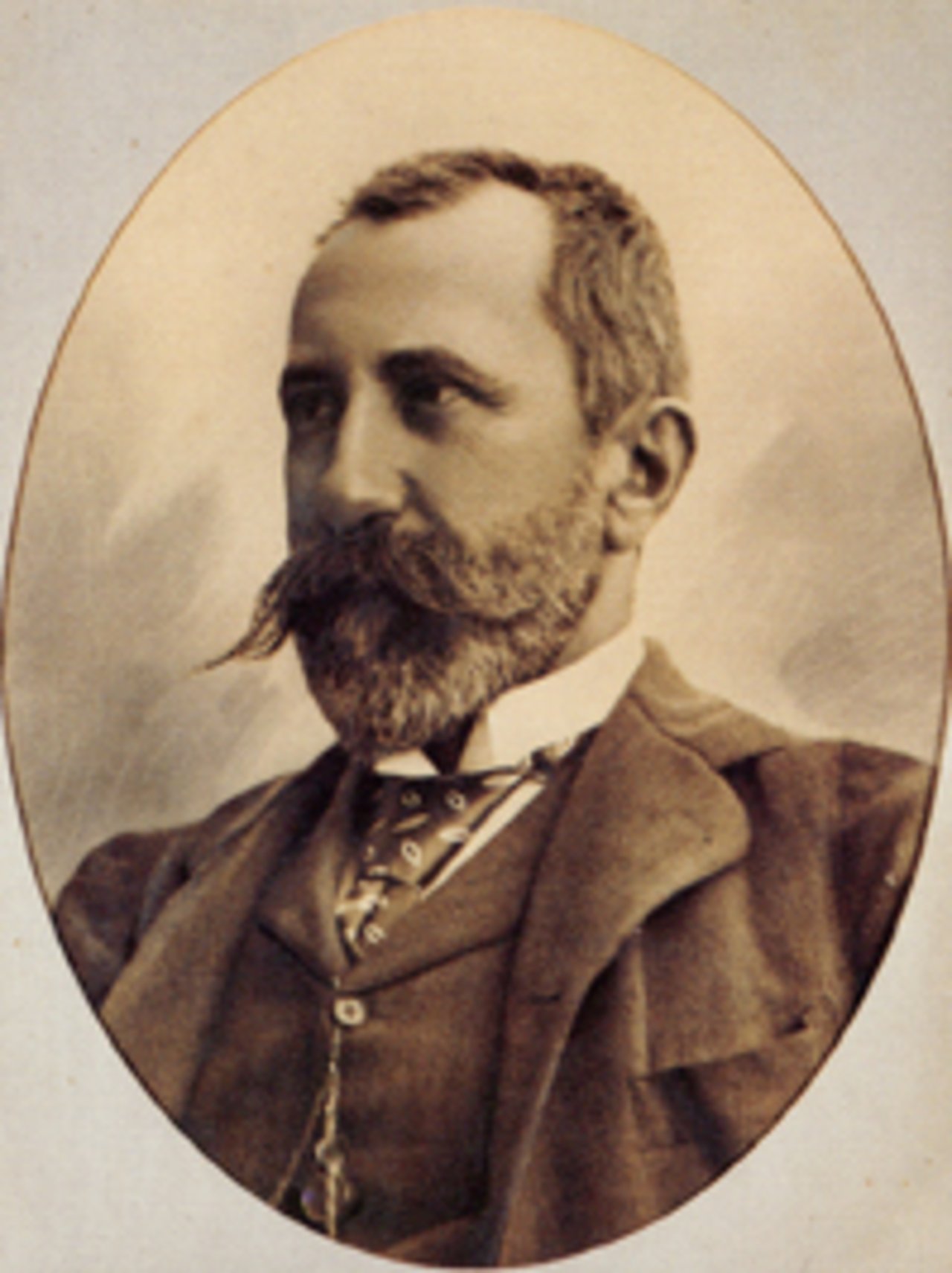
Portrait of Giuseppe Colombo
The arrival of electricity in Milan and Italy
Experiments with electricity were quite rudimentary at the time. The thermal power plant, named “Jumbo” in honour of the American elephant, was the pioneer in providing electric lighting at La Scala. Despite being prohibitively expensive, these power stations marked a new chapter in the history of lighting. In later years, electricity production moved outside the city, finding its place in hydroelectric power plants: initially along rivers, then in the mountains. The construction of large dams gave rise to an important Italian school in the early 20th century. The aim was to exploit the Alpine reservoirs created by these structures, bringing electricity to the Italian industries that were emerging at the turn of the century. Over time, Milan gradually erased the traces of these industrial experiences from its landscape. The Santa Radegonda power station was demolished, making way for a new building, now the Odeon Cinema.
Giuseppe Colombo, a life for science and technology
Born in Milan in 1836, Colombo was simultaneously an engineer, an industrialist and a politician. After graduating in mathematics, he devoted the period between 1857 and 1883 to teaching mechanics at the Società d’incoraggiamento di Arti e Mestieri in Milan, later extending his activities to Politecnico di Milano starting from 1865. His involvement in science and research focused mainly on the production and distribution of energy and the design of industrial plants and machinery. Thanks to this, he was able to spread ideas and issues typical of an industrial approach not only among insiders but also among the Italian ruling elite. At a time when most of these classes were still leaning towards growth based on agriculture, he helped to introduce new perspectives. His involvement in the dynamics of Lombard entrepreneurship was significant, working closely with rubber industrialist Giovanni Battista Pirelli and cotton magnate Eugenio Cantoni. In 1897, he became the director of Politecnico di Milano and held this title until 1911, while simultaneously being the president of the Consorzio degli istituti superiori in Milan.
Related stories

Nano sensor detects forever chemicals hidden in water
With METASENSE project, Margherita Maiuri aims to develop a compact and reusable device for monitoring PFAS in water.

Fluids, innovation and passion: the story of MISCELAB
We interviewed researchers Antonio Giuffrida, Dario Alfani, and Tommaso Toppi, who told us about the origins of the new laboratory and its future prospects.

Data, energy and diplomacy: Laura Cozzi’s vision for a fair, global energy system
Interview with one of the most influential voices in the international energy debate.

The history of hydraulics begins at the Fantoli Laboratory
A voyage into Historical Archives of Politecnico di Milano

How kites and drones can revolutionise wind energy
Discovering the new frontier of renewables
You might also like

Architecture is not architecture: Ma Yansong's lecture

Where design engages with living matter: B.Lab and the future of biodesign
The human being as part of an ecosystem. B.Lab, the new laboratory at Politecnico di Milano dedicated to biodesign and materials for transition, originates from this shift in perspective. Among mycelia, algae, bacterial cellulose and waste biomasses, the…
A robot in the barn: automating feeding on farms
Promoting technological innovation to support farms

Building the future, layer by layer
From intelligent 3D printing to bioprinting, Bianca Maria Colosimo talks about the technology that brings together data, space, and life sciences.
The app that tells the story of funerary rites at the Ancient Egypt Gallery
The app developed by the Department of Mechanical Engineering recounts, on an interactive screen installed in the Museum, the complex Egyptian funerary rites, with previously unseen images and detailed insights.