

Moisture: the enemy of composite materials. But now there’s a patented sensor.


The background
Composite materials such as glass fibre (GFRP) and carbon fibre (CFRP) are widely used in fields such as aeronautics; but one of the main problems associated with their use is their tendency to absorb moisture, and this has an impact on their strength and rigidity. Indeed, moisture can penetrate the material through small defects in the paintwork, microcracks or connection points and compromise its integrity over time.
Past events have shown how this can become a critical factor. In 2015, an Airbus A310 Polaris was involved in an accident that was linked to the combined effects of humidity and high temperatures, exacerbated by the dark paint on the composite structure. The famous Concorde was also involved in a serious accident in 1989; this was found to have been due to delamination between the layers of composite material, with moisture weakening the adhesive layer that held the parts together.
Such incidences demonstrate that moisture absorption in composite materials is not a minor issue. On the other hand, it is also important to be able to ensure the safety and longevity of these structures, especially those used in aeronautics.

Damage caused by moisture absorption in composite materials
What happens when a composite material absorbs moisture?
The moisture acts as a “plasticiser”, changing the mechanical properties of the material and making it less robust. In polymers, for example, it can interfere with the molecular bonds, weakening them or even rupturing them completely.

The most common forms of damage from moisture absorption are as follows:
- delamination, i.e. fracturing between the layers of material;
- the formation of cracks inside the material: these are known as intralaminar cracks and are not visible from the outside;
- poor adhesion between the reinforcing fibres and the matrix, leading to a deterioration in load-bearing capacity.
Laboratory tests have confirmed this tendency. Samples of GFRP and CFRP composites subjected to humid conditions and high temperatures showed a marked decline in properties compared to samples kept in dry conditions. These results highlight how important it is to research this issue and to develop solutions that reduce the impact of moisture on composite structures.

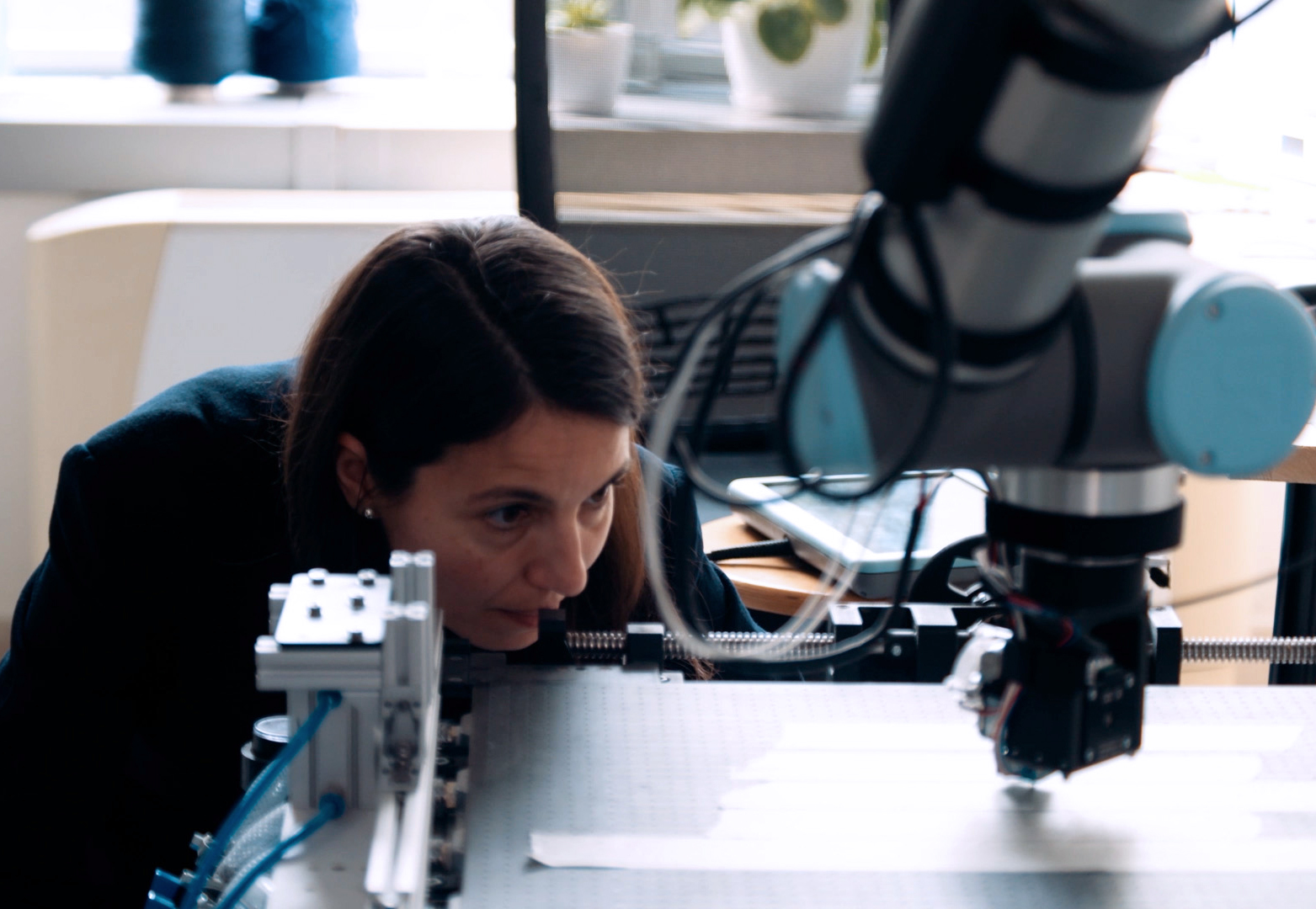
This device allows the glass to bond by joining the optical fibres with nanometric precision
The new frontier of monitoring: FBG sensors
In recent years, technology has made great strides in monitoring and preventing the damage caused by moisture and other factors. Among the most innovative solutions are Fibre Bragg Grating (FBG) sensors, which can be integrated into composite materials to monitor the health of the structure in real time.
The sensors can detect changes related to stress, humidity or damage, thus providing vital information. The main advances in this field include:
- the miniaturisation of optical fibres and components, making them much stronger and more compact;
- advanced sensor registration techniques to improve signal quality;
- robust systems, designed to function even in extreme operating conditions, such as high temperatures or severe vibrations.


Creation of the sensor
Fibre optic sensors also have certain issues in relation to the absorption of moisture by their polymeric coating. This absorption can produce errors in measurement, affecting the detection of thermal and/or mechanical loads.
The research team came up with an innovative way to resolve this problem, by turning what was a limitation into a solution.
The researchers decided to exploit the hygroscopicity of the coating to measure the moisture absorbed by the component. This idea led to the creation of a new patented sensor, which is able to use three FBG sensors to not only measure but also decouple the effects of thermal expansion, moisture absorption and mechanical strain.

Moisture sensor embedded in a resin test piece
Applications
The new patented sensor not only detects the amount of moisture absorbed by the component, but also provides vital data for assessing how much the mechanical properties of the structure have degraded, allowing both a thorough diagnosis and an estimation of residual useful life. This innovative monitoring system can be applied in a wide range of sectors, including:
- aeronautics and helicopters;
- ships and boats;
- offshore wind turbines.
Wherever there are composite structures exposed to humid environmental conditions, the sensor can help improve the safety and durability of the infrastructure.
This technology will increase the reliability of such structures in the future, marking a step forward in innovation and the protection of critical infrastructure.

Future prospects
This patented sensor opens up new scientific possibilities in the study of composite materials, allowing the development of more precise models for studying the effects of humidity and enabling research into intelligent coatings and multifunctional sensors. The data collected will be able to help international standardisation, and will encourage interdisciplinary collaboration for improving the safety and durability of structures.
Related stories
Circular Fashion-Tech Lab: where fashion becomes truly circular
Integrating design and advanced technologies from a more sustainable perspective

Where design engages with living matter: B.Lab and the future of biodesign
The human being as part of an ecosystem. B.Lab, the new laboratory at Politecnico di Milano dedicated to biodesign and materials for transition, originates from this shift in perspective. Among mycelia, algae, bacterial cellulose and waste biomasses, the…
In the laser museum where physics tells its story
Period instruments and pioneering prototypes trace a century of research, all the way to ultrafast lasers and attosecond science.

From micro to macro: the laboratory studying surfaces immersed in the future
Discovering SoLINano Σigma, that combines physics, chemistry, engineering and architecture

MINERVA, the device that reproduces cellular models for advanced studies and personalized therapies
A patent born at Technobiology Labs from the work of Carmen Giordano’s team
You might also like
Beyond true and false: recognising synthetic content in the age of AI
From cloned voices to deepfakes, the challenge is no longer just to distinguish what is true from what is false, but to understand how content has been produced, transformed and used.

Building in Balance
Matteo Scagnol and Sandy Attia of MoDus Architects discuss an architecture shaped by the tension between landscape and infrastructure, rules and freedom, materials and climate change.

Who owns Milan? Map reveals forces reshaping the city
The financialization of the real estate market and its effects on urban development dynamics

Technology in the desert: how to map in 3D Egyptian and Roman excavations using photogrammetry
An interview with Alessandro Mandelli, a veteran for Politecnico di Milano's excavations in Egypt

Reading Maps: The Taste of Discovery
Jessica Gritti discusses the research on the Maps section of the Civica Raccolta delle Stampe “Achille Bertarelli”: from cataloguing and new international connections to the value of collaboration between universities and cultural institutions.