

A sustainable future for lunar orbit


Over the past fifty years we have turned low Earth orbit into a depot of satellites, fragments and debris travelling at thousands of kilometres per hour. A problem that is becoming ever more pressing, between collisions, fragmentations and geopolitical tensions.
But while there the damage is done, there is another area of space where we are still in time not to repeat the same mistakes: the one between the Earth and the Moon. Mathilda Bolis, PhD candidate at the COMPASS Lab, in the Department of Aerospace Science and Technology at Politecnico di Milano, is working on exactly this: designing today the rules for a "separate waste collection" of the satellites that, in the coming years, will be launched towards the Moon. A pioneering work in which pure mathematics, chaotic dynamics and a certain "romantic" idea of research come together. Because, as she explains in this interview, doing research, for her, means above all one thing: attempting a "mad flight" towards what we do not yet know.
The research is funded by the Italian Space Agency as part of the ISTAR Grant Agreement No. 2023-37-HH.0, “Technical and scientific activities in support of C-SSA/ISOC and simulation of sensor architectures for SST”, which aims to develop research activities in the field of Space Traffic Management services.
Mathilda, how did you come to Politecnico and to space research?
My path has been quite linear. After scientific high school I had many doubts about which direction to take, but in the end I chose aerospace engineering, with the idea from the very beginning of continuing with space engineering. Of all the options, it seemed to me the one most tied to a dreamlike, exploratory dimension that I felt I was missing – and it was precisely this dimension that had made me doubt, at the start, that scientific subjects were my path.
Once I finished my master’s, I already knew I wanted to work on trajectory design, that is, designing and optimising the paths satellites will follow in space. It is one of the parts of mission development where pure mathematics is most applied, and it is also the very heart of the mission itself: not the final goal, but the conditio sine qua non, the one without which the mission simply cannot be carried out. Once I had graduated, I applied as a Junior Research Fellow to work on the design of a mission in the Earth-Sun three-body problem. I enjoyed that experience so much that I decided to continue with a PhD on a similar theme, tackling the same problem from a different point of view.
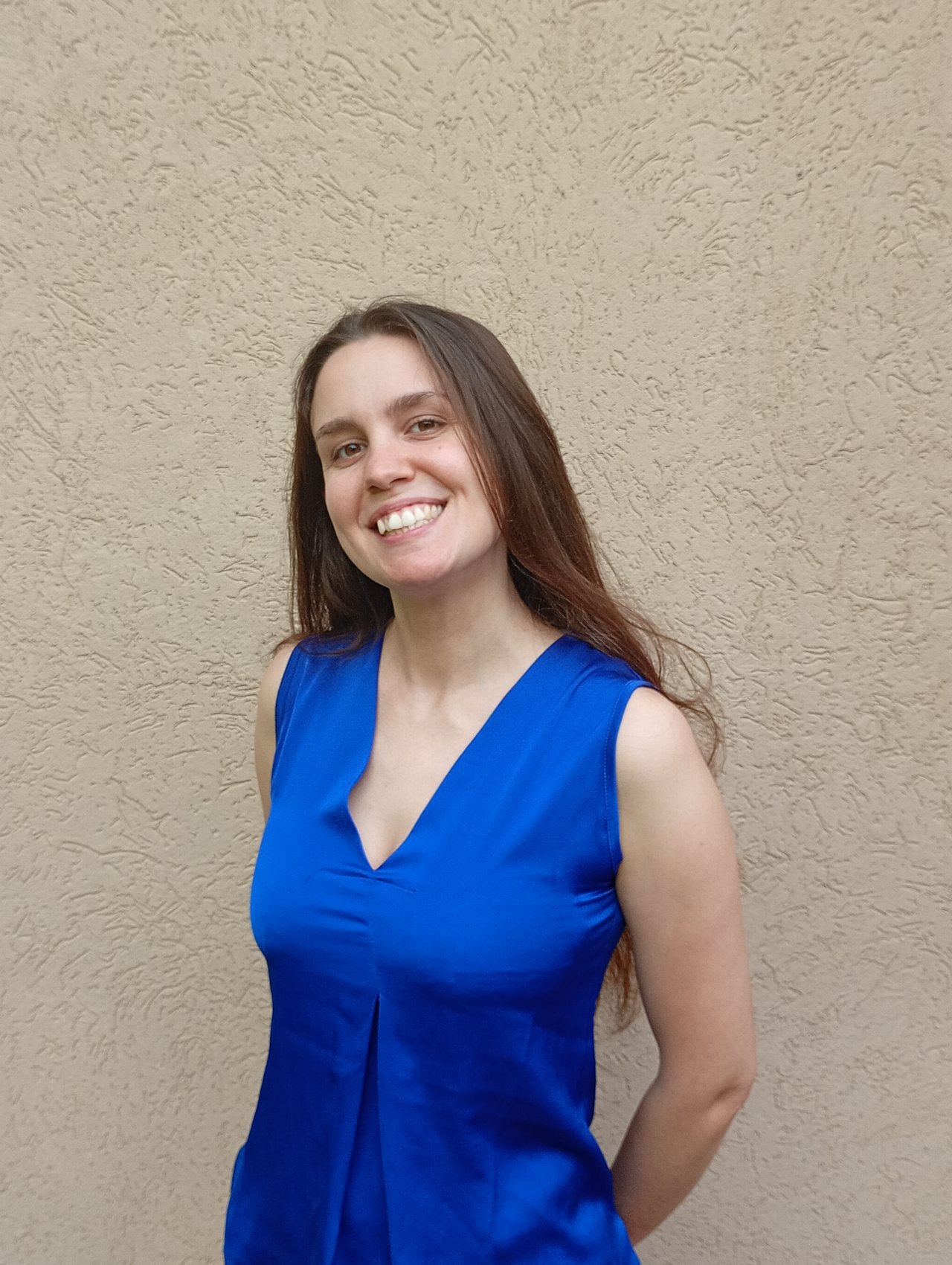
When you introduced yourself at the beginning, you told me you work on "separate waste collection in space". Could you explain what that means?
Our entire group, the COMPASS Lab, works on space sustainability. It is a subject I care about, and I am happy to work in a field that has to do, in a sense, with environmental protection. Doing space sustainability means devising strategies to solve or mitigate the problem of debris.
Over the past 50-70 years we have sent many satellites, especially into low Earth orbit, without worrying about what their fate would be at the end of the mission, nor about the possible interactions with the objects that were already there or that would be launched afterwards. The result is that we have managed to pollute an area of space that is naturally completely empty. Today we are seeing an increase in collisions between objects, both controlled and uncontrolled, and also in fragmentations: satellites that explode because they were not well built and that break apart into a great many small debris pieces, very fast and extremely hard to see from the ground. This creates a problem that is both economic, because a mission costs millions, and geopolitical, because much of space exploration is closely tied to the interests of state actors: if the satellite of one country is hit by another’s, the issue may not be only a technical one.
And how does your work fit into this context?
My work does not focus on the space around the Earth, as in the case of the other members of the group, but on the Earth-Moon system. Lately there has been enormous interest in returning to the Moon, and large infrastructures are being prepared for launch into lunar orbit. What I am trying to do is incorporate sustainability guidelines directly into the mission design, to avoid finding ourselves at some point around the Moon with the same problems we have today around the Earth. Concretely, this means designing the end-of-life phase of the mission: ensuring that, when the satellite has completed its task, it can be disposed of in an accurate and effective way.
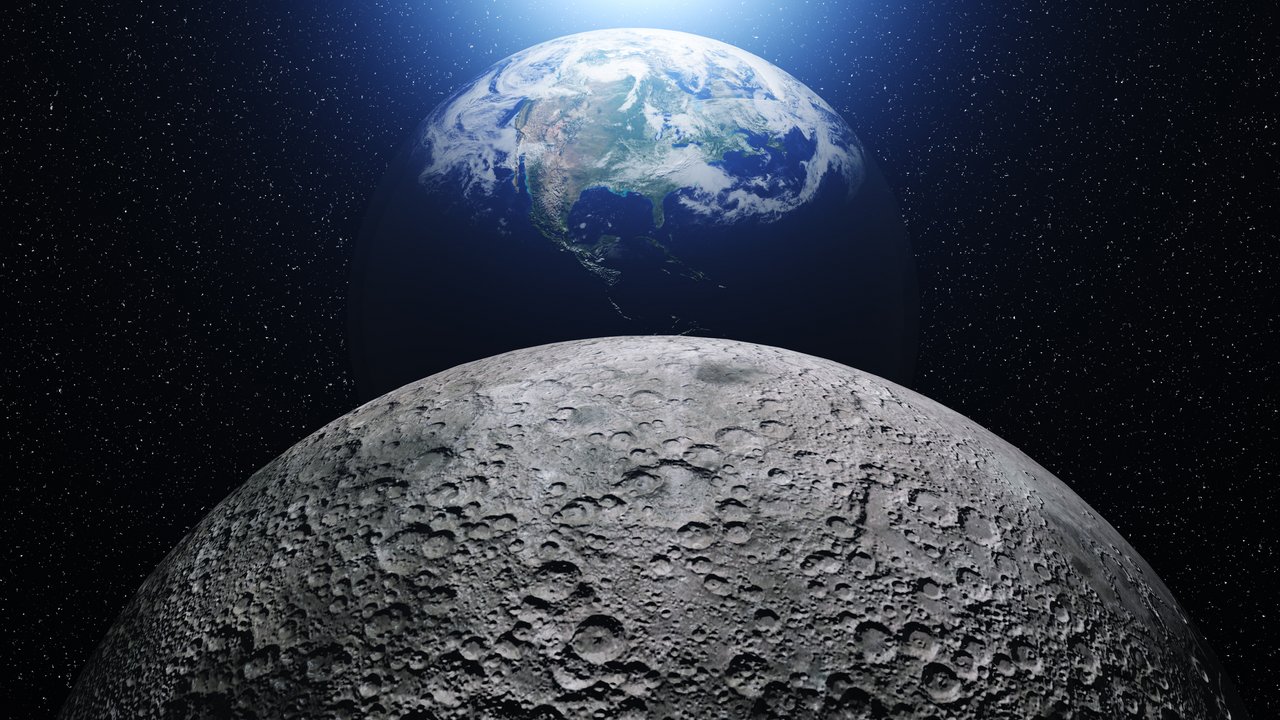
How do you "dispose of" a satellite?
In Earth-Moon space, a very wide area extending from above geostationary orbit up to the Lagrange points of the system, the main strategies are four, and the point is to understand when it is best to apply one or another.
The first is heliocentric disposal: with small manoeuvres, the satellite is placed on a trajectory that takes it out of the inner solar system, so that it no longer represents a danger for the area we are interested in. The second is the controlled re-entry to Earth, which, however, carries risks and must be planned very carefully. The third is impact on the Moon. The fourth is identifying "graveyard orbits", where end-of-life satellites can be parked, in effect creating a dump in a dedicated area of space.
Graveyard orbits are not chosen at random: we look for stable orbits in the three-body system, that also take into account solar radiation pressure and the perturbations of the gravitational fields of the various planets. The aim is to find solutions that, over a hundred years, show minimal oscillations, close to equilibrium points: in this way, even if the initial condition is slightly changed, the result remains the same. It serves to find robust answers in a system that is not robust at all.
In what sense?
In the sense that the dynamics of the Earth-Moon system is strongly non-linear and, in other words, highly chaotic. If I start from one point I obtain one result; if I start from a second point, very close to the first, I obtain a completely different one. This means we have little control over what happens to the satellite, and it is precisely for this reason that it becomes essential to think about disposal already at the design stage. Leaving debris around the Moon would mean making that area of space very difficult to reach, to use for future missions and far more complex to analyse, from many points of view.

Scientific chart showing the relationship between Delta-V and time of flight (ToF) for different space maneuvers, with color-coded points representing the initial angle.
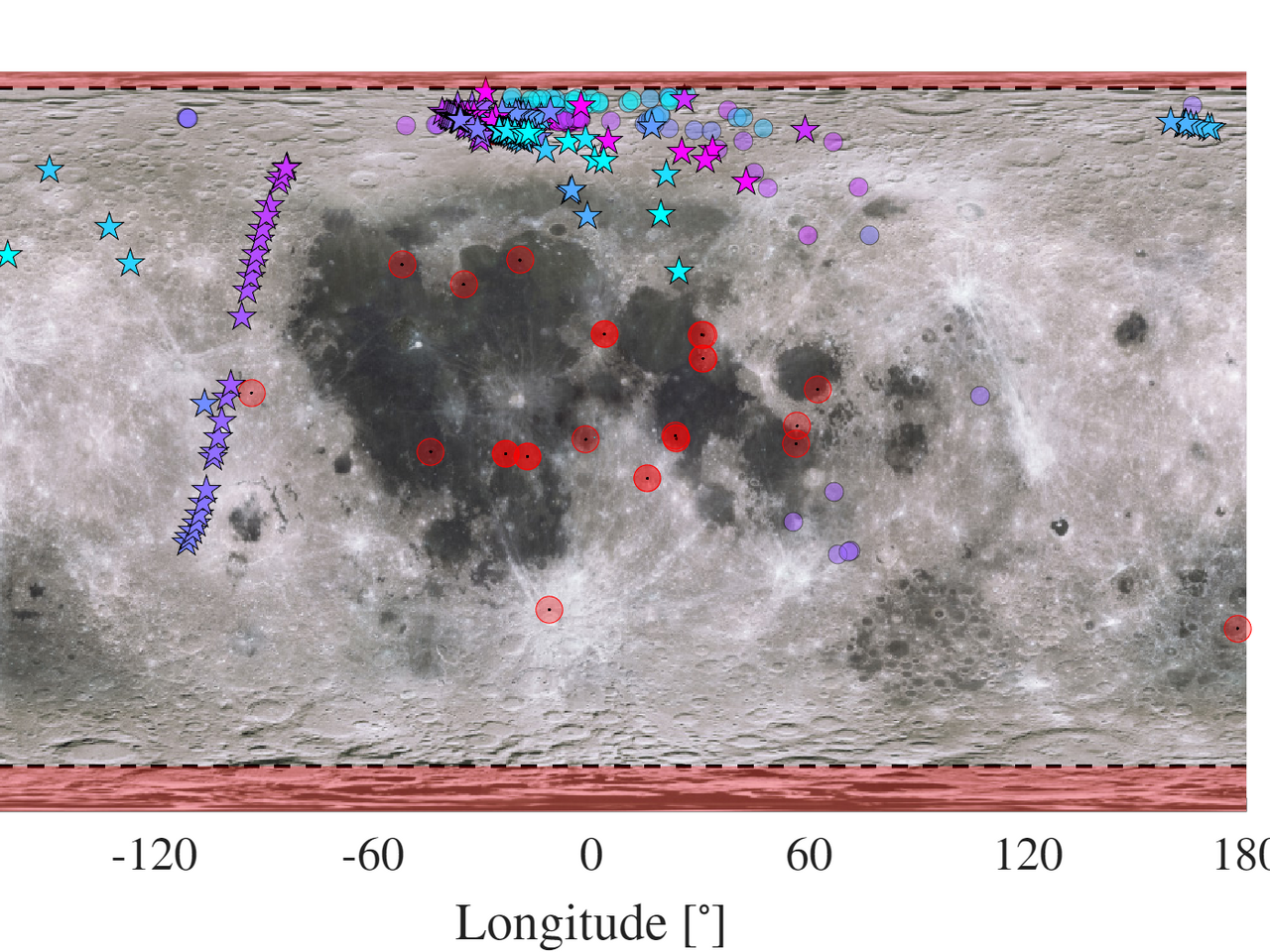
Scientific visualization of the Moon using an equirectangular lunar surface map. The image displays multiple impact sites and spacecraft trajectory paths distributed across lunar latitude and longitude coordinates. Colored markers represent different orbital parameters through a 0°–360° color scale. The figure highlights impact regions, polar areas, and navigation dynamics within the Earth–Moon system.
What were the biggest challenges of such pioneering work?
The greatest difficulty of my PhD is that studies focusing on end-of-life disposal in the Earth-Moon system are still very few: it has been somewhat like starting from scratch. We had to devote a great deal of time to preliminary analyses, such as understanding which parameters truly drive the dynamics of the system.
From an academic point of view, the biggest challenge has been retrieving the existing literature and understanding which tools could be repurposed for a topic different from that of orbital transfers, which has, by contrast, been extensively addressed up to now. We do, in a way, the opposite of a classic Earth-Moon mission project, with completely different objectives: it has been a matter of turning those studies into useful tools for a new problem.
The idea we are working on is a kind of "metro map" of cislunar space: something that, given the starting point, tells me where I can go. What we want to do is to identify which variables of the system allow me to remain in a zone of a possible phase space that guarantees robustness, even in the presence of chaos.
Where are you in the process? Have you already tried to apply this work to real missions?
We are still in a study and analysis phase. What I do has never been applied to a real mission: not because it is far from being so, but because the problem is finding a mission to which to apply it. The "metro map" is useful if I have a very wide range of missions to refer to, and at this moment that range is not yet there. At present there are not many satellites already in orbit around the Moon, and those about to be launched are few. We know that many missions will arrive in the coming years, so ours is work designed for the future.

Scientific infographic illustrating multiple orbital trajectories and dynamical scenarios within the Earth–Moon system. The image presents direct and indirect escape paths from the L1 and L2 Lagrange points, along with examples of Earth impacts, Moon impacts, and non-escaping orbits. Trajectories are color-coded according to initial angular parameters, providing an advanced visualization of orbital mechanics and cislunar mission dynamics.
How important is it to convince those who design and launch missions to incorporate these guidelines from the outset?
In my view it is very important. But we run into the same obstacles as anyone working on sustainability in any field: making sustainable choices comes at a cost, and operators are not always willing to bear it. It is hugely important, but it is hard to make people understand just how much.
The point is that, if we do not, we risk simply no longer being able to reach the Moon or place satellites in orbit around it. Every time we do not carry out a disposal, or do not adhere to a sustainability guideline, it is as if we were losing access to slots of space. And it is like passing the problem on to those who come after us: in ten years, someone will have to design the same mission I am designing today, and they will also have to deal with my satellite, which by then is who knows where, and which could put at risk a project that has cost a great deal of money and effort.
You have described research as Ulysses’s "mad flight”. A powerful metaphor. Could you tell us what it means to you?
I find it somewhat hard to engage with the more applied side of engineering. Fitting screws and bolts or writing code is nice and interesting, but it is not what truly inspires me. Ulysses, in the Divine Comedy, at one point declares “De’ remi facemmo ali al folle volo”, describing to Dante how he urged his companions to cross the Pillars of Hercules and to pass beyond the boundaries of the known world. And I think there is no better way than this to describe what research is for me. For Ulysses, the oars are the means to sail further than anyone else has ever done, just as for me technique, sheet metal and equations are the means to be able at least to try to glimpse something we perhaps did not even know was there to be discovered. The horizon is no longer a limit, but a call, towards which we push because it is the only way we have to make progress.
For me, research is placing knowledge on a pedestal, trying to push further than what is known, undertaking this mad flight towards which we are not even sure why we are bound, but towards which, inevitably, something drives us. What is research if not a battle against windmills that only a madman would undertake? So much so that sometimes you ask yourself, why am I doing this? And my answer is that one wants to reach where no one has yet arrived, higher than what we were given to know, curious to discover something new, guided by wonder at the world.
The beauty for me is that I think what I do fits this idea very well. In my work there is a whole dimension of studying the dynamics of the system, of the way things move in the universe, that is very far from application: it would be easier to find a solution that works as a one-off, but if you really want to understand what is happening you have to push further. You must look for the why behind the behaviour of a system, not just the how. For me, doing research is not simply developing a technique, or designing a fine mission: it is being something halfway between a scientist and an explorer. The kind we used to be told about as children. In my view, this is the heart of science: discovery, setting off on a mad flight towards unknown lands, with curiosity and dreams as travelling companions.
You might also like

Geopolitical instability, health crises: the risks in the pharmaceutical supply chain, and how to manage them

From circuit to laboratory
The collaboration with the Politecnico as seen by Autodromo Nazionale Monza

Research Takes to the Track at Monza
The agreement between Politecnico di Milano and the Monza National Circuit creates an open-air laboratory for safety, sustainability, materials, mobility and major events.

Digital sovereignty: why regulating AI is not enough
Interview with Roberto Baldoni, Senior Advisor for Technology and Cybersecurity Policy to the Ambassador of Italy to the United States
The creative force of mathematics, in the words of Sachiko Nakajima
The scientist and pianist is a tireless promoter of topics such as STEM, diversity and inclusion. In this interview she told us about her artistic world and her vision of mathematics.