

DriSMi, the Politecnico di Milano Driving Simulator


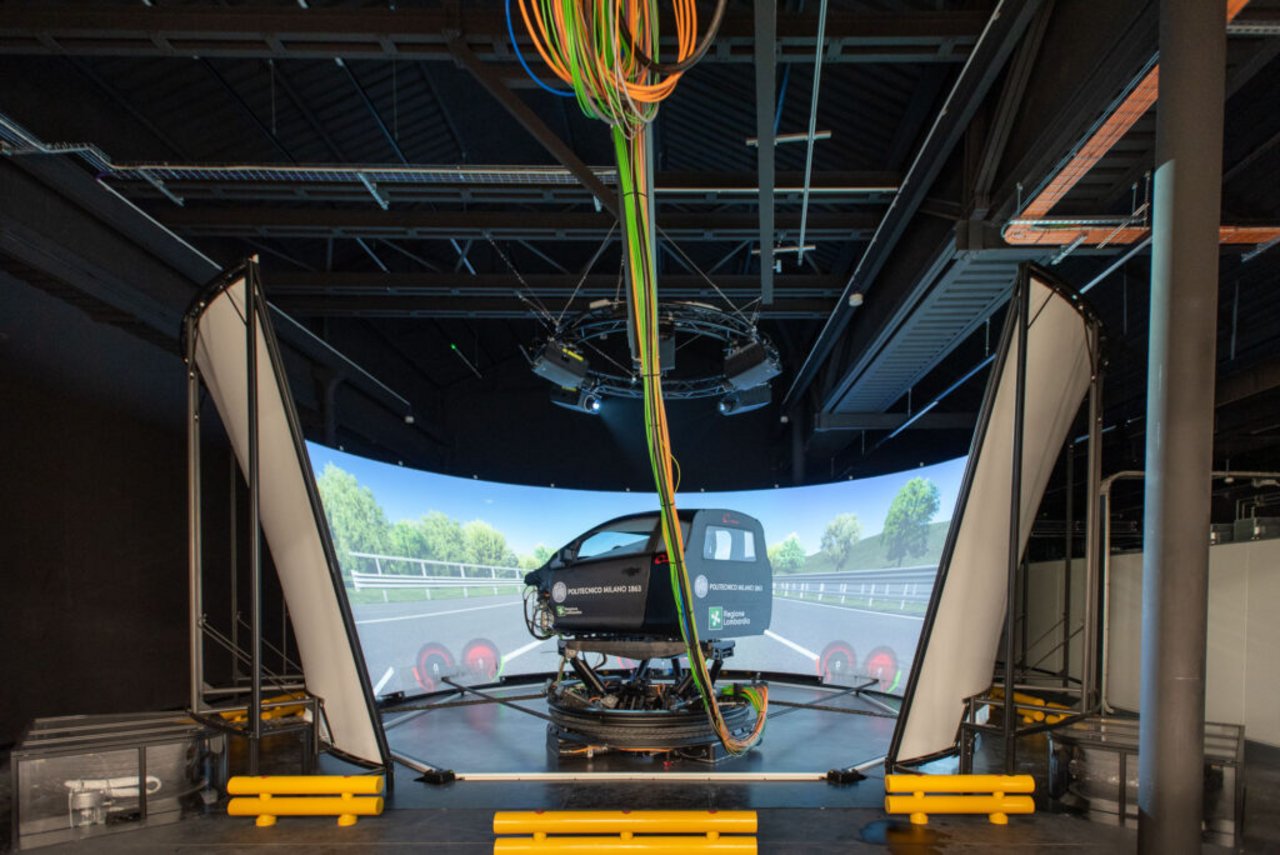
The Politecnico di Milano hosts the world’s first installation of the DiM400, the most innovative dynamic driving simulator on the market today, co-funded by the Region of Lombardy and designed and engineered by VI-grade.
The DiM400 is a unique tool for the development of sustainable mobility, making the acquisition of fundamental value to scientific research in the automotive field. The driving simulator is used in the design and construction of new environmentally-friendly vehicles, the development of components involving the innovative use of materials and applications related to vehicle dynamics. It is also used for consumption optimisation, verifying the functioning of active safety systems, applications connecting vehicles and infrastructure, autonomous driving applications and the development of sustainable motorsport.

In the DiM400 system, the driver sits in a realistic cockpit facing a large widescreen displaying the scene that they would see in a real vehicle, immersed in a vibro-acoustic environment that resembles reality, using the vehicle controls and receiving the same feedback that a driver would receive when driving a real car. The mobile cockpit uses simulator motion and the integrated active systems, seats and belts to subject the driver t to the exact same forces as they would experience in reality as a result of the acceleration reached by the vehicle when following the set route at the desired speed.
The simulator system is therefore capable of integrating and rendering perceptible to the driver the various mechanical, electric, pneumatic, hydraulic, electronic and computer components that determine vehicle performance and environmental connectivity under different operating conditions.
The DiM400 is equipped with an innovative cable-based movement system, which offers a broader field of motion, exposing the driver to greater acceleration and for longer periods of time. A new component called “hexalift” also improves vertical movement by increasing the available travel, which in turn generates a more realistic driving sensation for combined motion.
The driving simulator has several advantages: from being able to demonstrate the potential of innovations in a safe environment before they are produced, to the opportunity to experiment and perfect all advanced assisted or autonomous driving systems.
Just as important is the possibility of testing the interaction between road users and infrastructure, such as traffic sensors, before they are built, and developing research on driving safety and interactions between vulnerable users, vehicles and infrastructure. When it comes to sustainable and smart mobility, this is a particularly important function for building a transport system capable of reducing road congestion, pollution and hazards.
Finally, the simulators are also a fundamental tool for teaching: they enable the original and immediate study of vehicle dynamics and driver-vehicle-infrastructure interaction, teaching best driving practices and the reconstruction of road traffic accidents.
The system cost €5 million , of which €2 million in funds from the Region of Lombardy, and is located on the Bovisa campus of the Politecnico. It is at the jewel in the crown of a project promoted by the Lombardy Mobility Cluster – No 4 in Europe – which aims to create a regional hub for local automotive companies.
You might also like

Studying drug safety in pregnancy: the PROTECT project
The safety of medications during pregnancy remains one of the most complex and least explored areas of medicine: PROTECT was created to fill this gap.

The invisible price of soy
From Brazil to China, the journey of a crop that consumes water, land and forests

Nano sensor detects forever chemicals hidden in water
With METASENSE project, Margherita Maiuri aims to develop a compact and reusable device for monitoring PFAS in water.

Where Engineering Meets the Brain
Between neural models and precision medicine, Alberto Antonietti works to better understand neurological diseases.

BAMBI: when research meets life
A safe, accessible, and easy-to-use device to counter postpartum haemorrhage.