

What if the answer to “Are we alone in the universe?” is hidden in a laser?


There’s a common thread that runs through over forty years of research, and links biomedicine, fibre optic telecommunications, and the search for exoplanets: it is the special light of lasers. Paolo Laporta, a graduate from the Politecnico di Milano in 1979 and now a full professor of Experimental Physics, has spent his scientific career exploring the potential of this extraordinary light source. His career pathway shows us how basic research can open up unexpected avenues and link worlds that might appear very far apart. His initial studies were into dye lasers – when such a doctorate did not yet exist in Italy; he then went on to collaborate with the telecommunications industry, and more recently to develop sophisticated optical frequency combs for observing planets many light years away.
And now, with the NIR AstroComb project, laser physics meets astrophysics to probe one of the most intriguing questions ever: are we alone in the Universe?

Professor, what is your field of research and how has it evolved over time?
The common thread in my scientific work has always been laser physics and the development of laser sources for specific applications. When I graduated in 1979, the laser had been around for more than ten years; there had already been some important results in this field, but there was still enormous scope for development both in studying the devices and in applications.
I was initially working with dye lasers and applications in the biomedical field. I then started to examine the more basic aspects of this device, such as optical resonators, one of the essential components of the laser, and the properties of laser beam propagation.
After some time at the University of Rome Tor Vergata, I returned to the Politecnico di Milano in 1991, and concentrated intensively on optical communications during that decade. It was a period of great turmoil: the widespread use of fibre optics was radically changing the way information was transmitted. We were working on a new source in particular, the erbium-ytterbium laser, and collaborating with leading companies such as Italtel and Pirelli.
In the following years, I worked on solid-state lasers for spectroscopic applications, shifting the focus to the infrared region of the spectrum. I concentrated my research on mode-locking in lasers and so-called frequency combs: devices that are now right at the heart of the project we’re discussing.
We’ve always had a twofold aim throughout this journey: to study the physics of the device, and also to develop it in terms of a practical application, often working together with other research groups.
Let’s get to the heart of the NIR AstroComb project: what’s it about and why is it so innovative?
The name actually sums up the concept: “NIR” stands for “Near Infared”, and “AstroComb” combines astrophysics and the laser frequency comb. So it’s a laser-generated optical frequency comb, designed to operate in the near-infrared region and applied to astrophysics.
The project was conceived at a meeting between our group, consisting of researchers from the Department of Physics at the Politecnico and the Institute of Photonics and Nanotechnology of the National Research Council (which is based in our Department), and a group of astrophysicists from the University of Catania and INAF. It’s classed as a Research Project of Relevant National Interest and in receipt of national funding, which has enabled us to develop a new type of laser source that is specifically designed for an astronomical application.
The aim is to contribute towards research into exoplanets and their characteristics. Until 1995, we had no experimental evidence that there were any planetary systems like our solar system, orbiting around other stars. That year, two Swiss astronomers, Michel Mayor and Didier Queloz, discovered the first exoplanet fifty light-years from Earth, a discovery that earned them the Nobel Prize for Physics in 2019. The number of exoplanets discovered has grown enormously since then, amounting to several thousand. But the real challenge now is not just in finding more; it’s in understanding how many of them might be similar to Earth.

An exoplanet is a planet that orbits a star other than our Sun, so a star outside our Solar System. We know our own Solar System really well; the Sun lies at the centre and the planets, including Earth, all revolve around it. But there are millions, indeed billions, of other stars in our galaxy. Until thirty years ago, we had no idea whether there were any other planets around them. But we are now beginning to realise that there are huge numbers of these planets. The next, even more intriguing challenge will be to find out how many of them are in the so-called habitable zone, i.e. located at such a particular distance from their star that they could potentially host (or have hosted) life forms similar to those we know on Earth.
What’s the link between a laser and the discovery of a planet many light years away?
Planets don’t emit their own light and, unlike stars, they don’t shine with their own light. This means we can’t observe them directly, except in certain exceptional instances. The most effective way to detect them nowadays is by means of radial velocities.
When a planet orbits a star, it’s not just the planet that moves. Due to the effects of mutual gravitational attraction, the star also makes a small, regular movement around the centre of mass in the system. Although the planet may have a very wide orbit, the movement of the star is tiny but regular over time.
This movement causes minute shifts in the spectral lines of starlight, due to the Doppler effect. Many people know the Doppler effect in the field of acoustics: when a siren is approaching, the sound gets higher, and when it moves away, it gets deeper. The frequency shifts according to the movement of the source in relation to the observer.
The same phenomenon occurs with light. If a star is approaching, its radiation frequencies get slightly higher; if it moves away, they get slightly lower. Of course, these are infinitesimal variations.

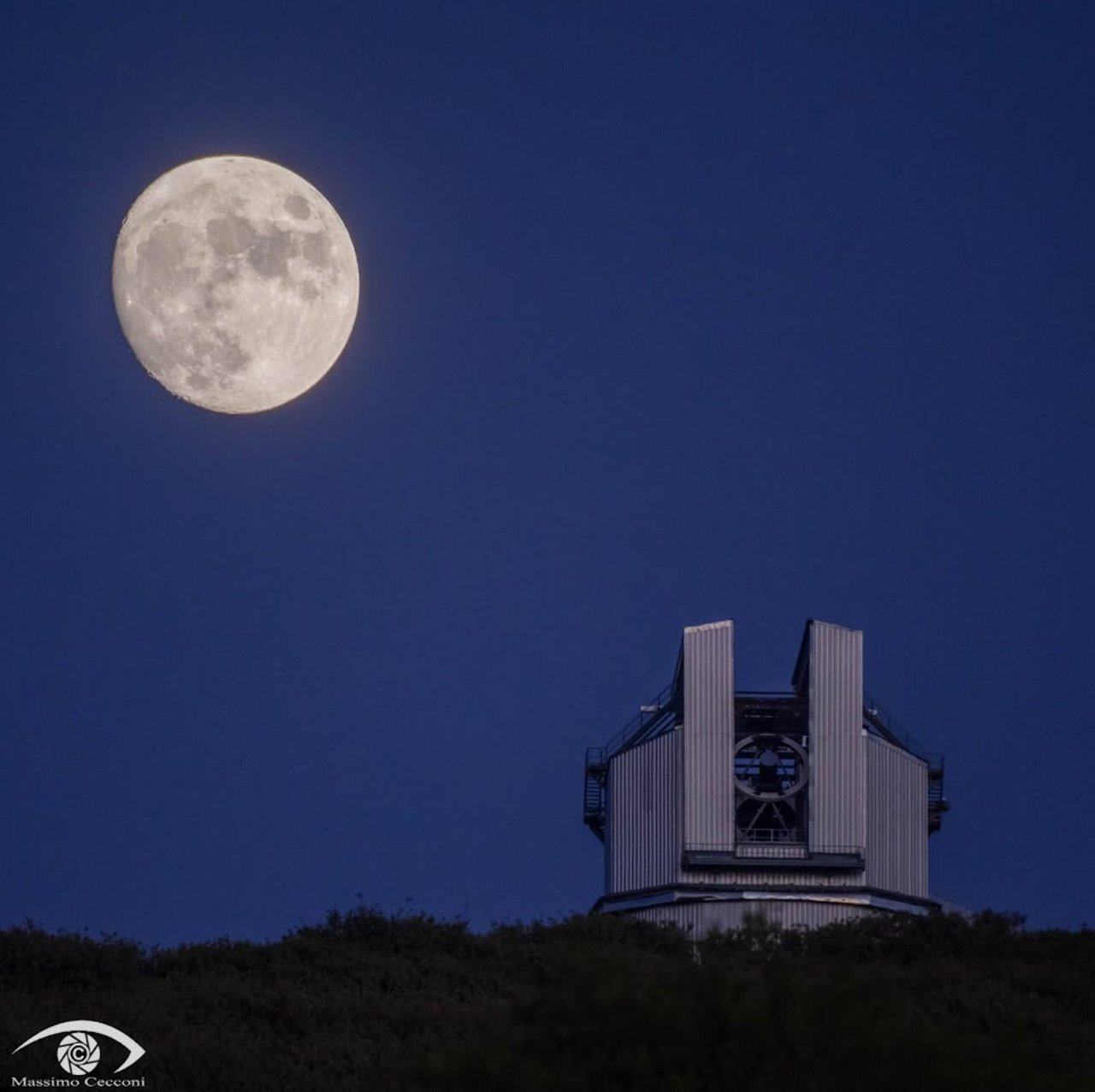
The Galileo National Telescope (Roque de Los Muchachos, La Palma, Canary Islands, 2,370 m above sea level) during nighttime observations with its dome open. © Courtesy Massimo Cecconi, TNG astronomer.

The Galileo National Telescope (Roque de Los Muchachos, La Palma, Canary Islands, 2,370 m above sea level) during nighttime observations with its dome open. © Courtesy Massimo Cecconi, TNG astronomer.
So what role do lasers and optical frequency combs play in this process?
The central issue is the accuracy of the measurement. The Doppler shifts in the spectral lines of stars are infinitesimal, and require extremely stable and consistent spectrograph calibration.
This is where the laser frequency combs come into play. Unlike a traditional laser, which is basically monochrome, a mode-locking laser emits thousands of different frequencies. Thanks to the pioneering work of Theodor Hänsch and John Hall – who also won the Nobel Prize in Physics in 2005 for their invention of the laser frequency comb and precision spectroscopy – these systems have been stabilised in such a way that the frequencies are perfectly equidistant and completely stable over time, with a precision that is often in excess of 10¹².
The result is a real “comb” of frequencies: a series of uniformly spaced “optical teeth” that cover a broad region of the spectrum, acting as a special optical ruler.
The light from the frequency comb is coupled to an astronomical spectrograph along with the light from the star. The comb provides an extremely precise and continuous system of calibration, enabling the instrument to be calibrated with a degree of stability that was unthinkable in the past.
This is crucial, because the observations need to last for months or even years in order to determine the periodicity of the movement of the star. Without such an exact and stable calibration over time, it would be impossible to detect the Doppler shifts. It is this capacity for taking measurements that makes the physics of lasers such a crucial tool in the search for exoplanets.
Why did you choose to work in the near-infrared spectrum?
Most of the optical combs used in astrophysics up to now operate in the visible spectrum. We decided to move into the near-infrared for a very particular reason; about 70% of the stars in our galaxy are red dwarfs, i.e., stars that are smaller and cooler than our Sun.
Red dwarfs are extremely interesting from an astrophysical point of view. They are very long-lived; while our Sun is estimated to be about ten billion years old (and is now about halfway through its life cycle, and so is an “adult” star), red dwarfs can live for many tens of billions of years. This means that they take a very long time to evolve, and so have potentially greater opportunities for developing stable planetary systems.
Considering that they are also the commonest stars in the galaxy, it’s very likely that there are many exoplanets orbiting these stars that are also similar to Earth, and so located in the habitable zone.
However, there’s an important aspect to consider; as they are cooler than our Sun, red dwarfs emit most of their radiation not in the visible spectrum, but rather at lower frequencies, and so in the near and mid-infrared region. So, to study them effectively, we have to work in that spectral region. That’s why we developed a laser frequency comb that operates in the near-infrared region.
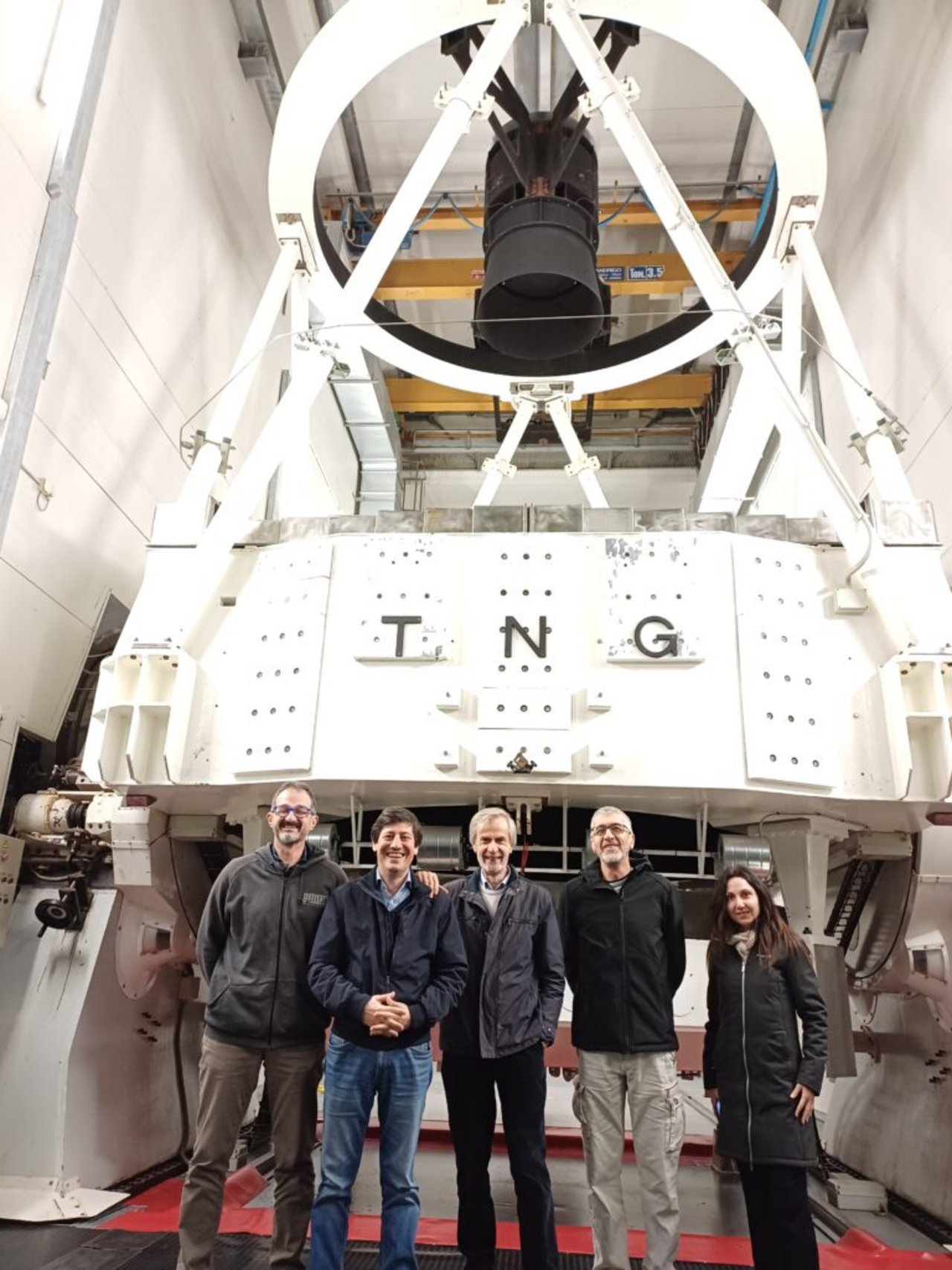
Our system covers a very wide spectral range (from about 900 nanometers to 2.4 micrometers – so a span of more than an octave), using methods of supercontinuum generation into non-linear media. It has been specially designed to be coupled with the GIANO-B infrared spectrograph, in operation at the Galileo National Telescope (La Palma, Canary Islands).
The comb was therefore “custom-built” to cover the entire spectral range of GIANO-B, and to provide an extremely precise and stable calibration system over the long term. We are currently verifying it at our laboratories in Milan; the aim is to transfer it to the Galileo National Telescope by the end of the year, and to make it operational in 2027.
Similar instruments could also be developed in the future for other large international observatories, like the ESO observatory in Chile, where the ESPRESSO spectrograph is in operation. However, every spectrograph needs a comb that is specially designed to suit its particular optical characteristics and its spectral band.
As well as exoplanets, what other prospects lie ahead for this technology? And what advice would you give to young researchers?
This precise calibration could be used not only when looking for exoplanets, but also for studying stellar atmospheres, or for testing the invariability of fundamental physical constants over the course of time. Optical combs also have potential applications in optical communications: thousands of spectral lines could enable thousands of parallel channels of data transmission.
With regard to young people, I believe that enthusiasm is what matters most in research. This sort of work can provide great satisfaction, but also includes periods of frustration, especially in a context of fierce international competition. It’s important to choose an area that really excites you, build up grounded knowledge over time and become recognised as experts.
At the same time, you have to keep an open and curious mind. Research is tending to become increasingly specialised nowadays, but the most intriguing innovations are often the result of different disciplines working together. Our project is an example: laser physics encountered astrophysics, and this process of cross-fertilisation led to a new idea.
Developing a combination of rigour and openness, expertise and curiosity, is perhaps the hardest – but also the most stimulating – challenge for anyone embarking on a pathway in scientific research today.
You might also like
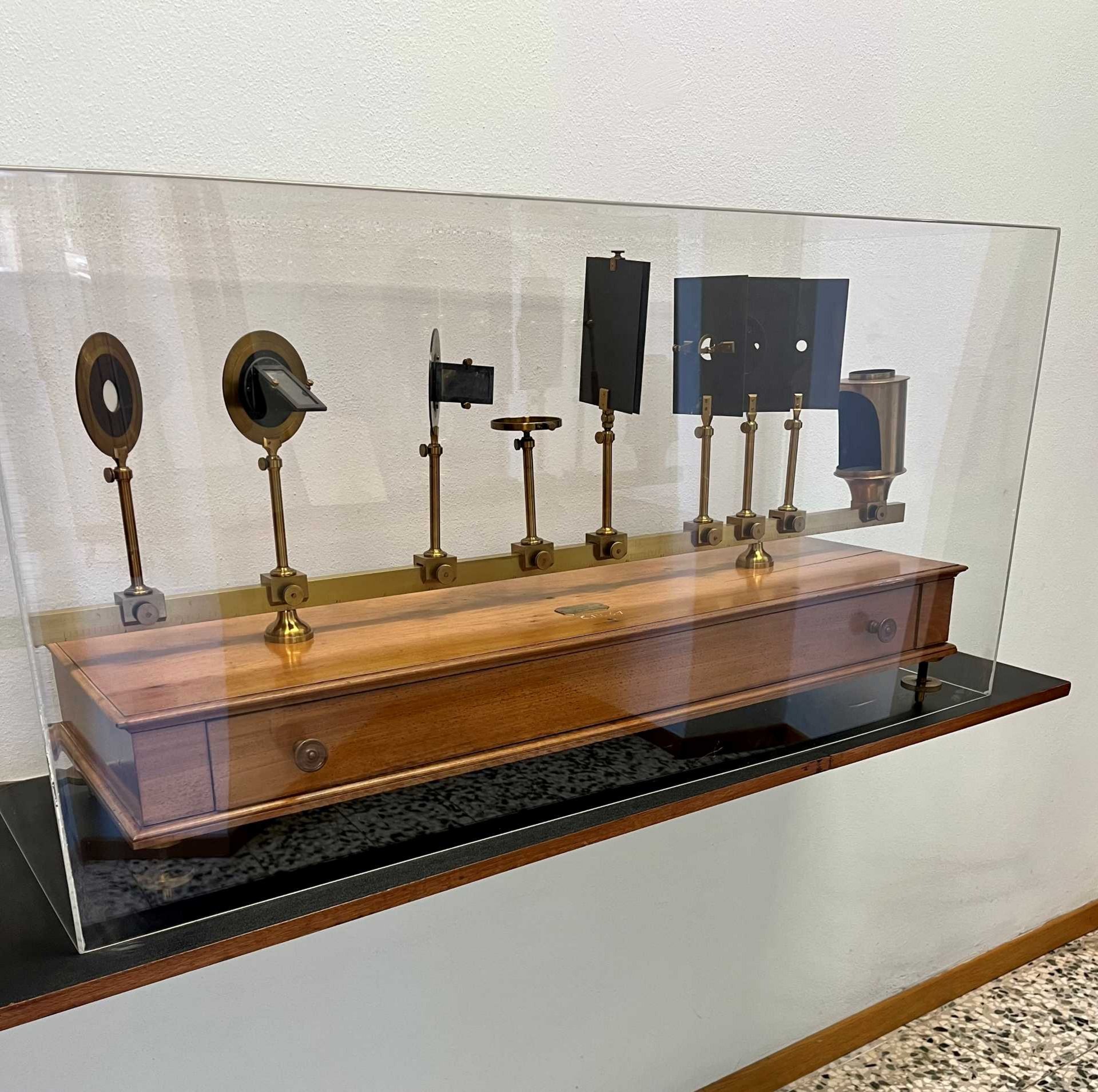
In the laser museum where physics tells its story
Period instruments and pioneering prototypes trace a century of research, all the way to ultrafast lasers and attosecond science.
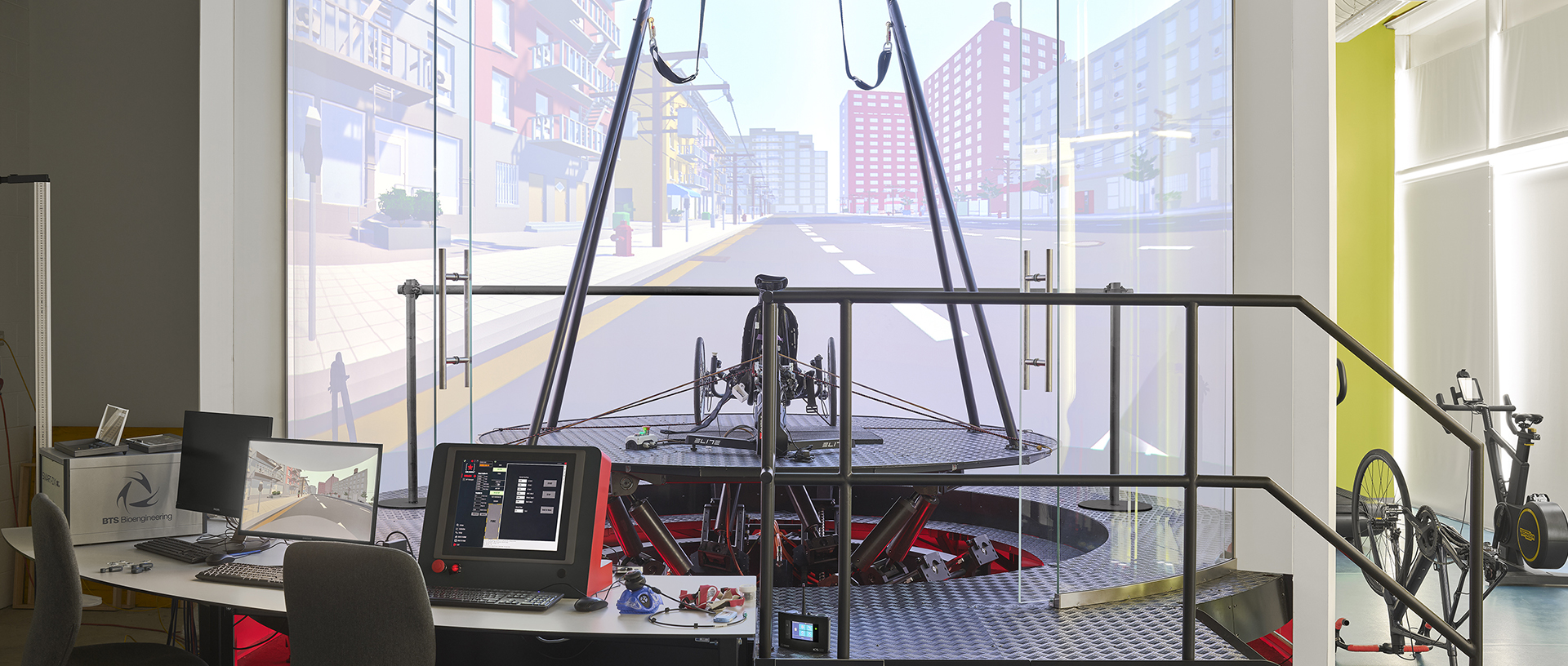
Bobsleigh, bicycles, wheelchairs and feet: Lecco’s HexaLab is the world’s most advanced multi-sport simulator
The HexaLab at the Lecco Campus is based on the “human-in-the-loop” approach, whereby a human operator can control the simulator and physically interact with the equipment and the “simulated” environment around them

People and ideas behind the glasses of the future: research stories from the Smart Eyewear Lab
A passionate account of the Politecnico di Milano and EssilorLuxottica laboratory, through the voices of its researchers

Art, science and technology in the unique design of Horacio Pagani’s hypercars
A close-up with the Italian-Argentinian entrepreneur, founder of Pagani Automobili, who revolutionised the automotive sector with his talent
