

The creative force of mathematics, in the words of Sachiko Nakajima


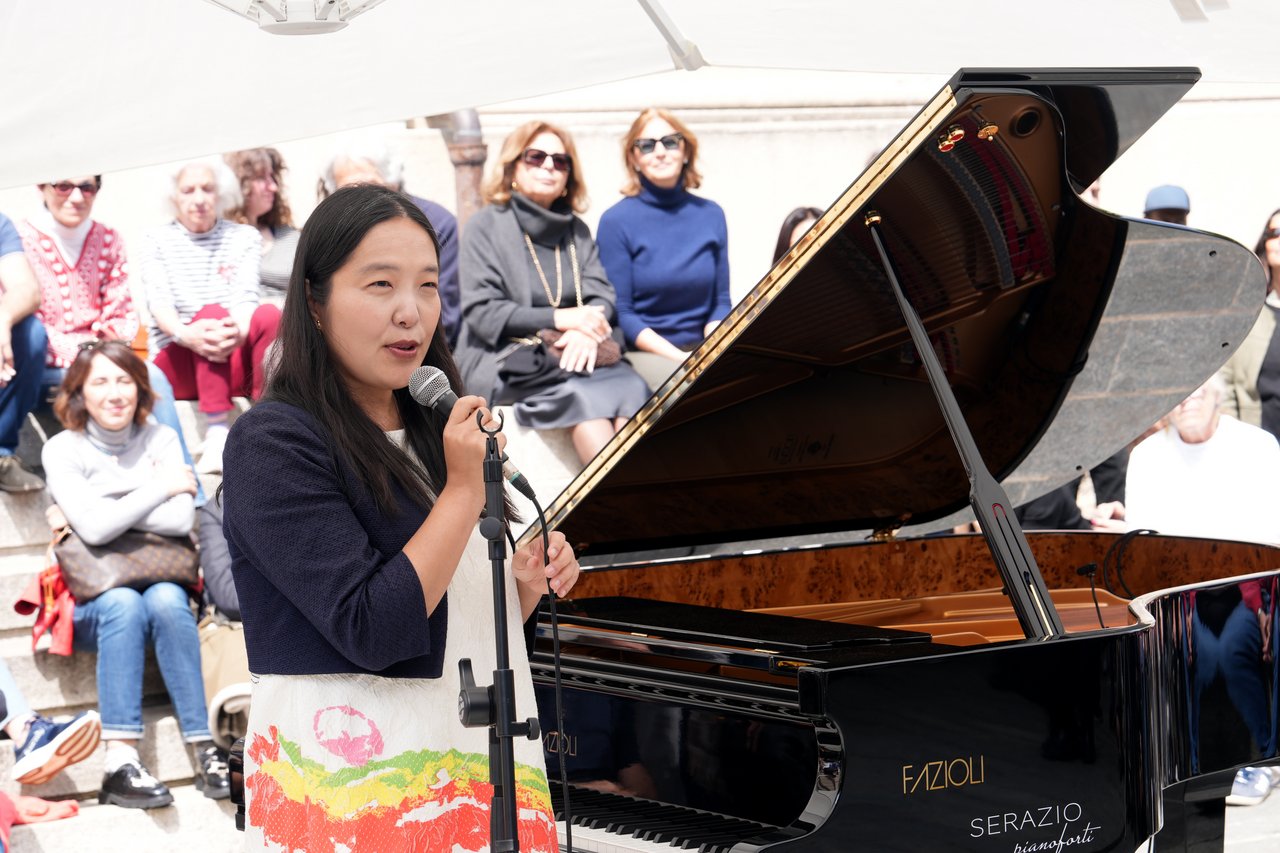
Music and numbers. They’re the fiercely strong passions that drive Sachiko Nakajima, a pianist and a mathematician, who played at Politecnico di Milano’s gardens in piazza Leonardo da Vinci for the Piano City Milan 2026 edition. Her performance came as the result of Italy’s participation at Expo 2025 Osaka in Japan, where our country’s Pavilion was crowned as the best one, and where Sachiko Nakajima acted as the curator and producer of the Jellyfish Pavilion: a special project promoting STEAM (Science, Technology, Engineering, Arts, Mathematics) subjects, inclusion and diversity into society.
Being a scientific advocate herself, as the CEO of steAm, Inc., the aim of Sachiko Nakajima is to empower more girls to embrace these subjects. At the Jellyfish Pavilion she promoted multiple activities about them, creating an immersive playground where people could experience the beauty of nature and of the science that lies beneath it, and also experience it directly from disabled people’s points of view, all in a joyous and spontaneous way. There, she also interacted with many Italian artists while the Expo unfolded, playing live with them – along with the resident musicians of the Kurage (i.e. jellyfish in Japanese) Band.
At Politecnico di Milano’s venue, Sachiko Nakajima performed some of her own pieces intertwined with old Japanese folk songs: she captivated the audience with her musical tales about red dragonflies and tanukis (i.e. Japanese racoons) and other typical fauna of the surroundings of Osaka, where she was born and raised. We talked with her about her musical influences, and how mathematics can be a real creative force.
You were the first woman in Japan to win the International Maths Olympics. How did it feel for you to pave the way for other girls and women to follow the same steps? How’s the situation in Japan about girls in STEM subjects?
In Japan the situation is not so good yet, we still have a lot of issues. Our current Prime Minister is a female, but it’s still a very male-dominated world, and for girls it's really tough to get into it, especially in mathematics and engineers. It's really difficult to state those kinds of unconscious bias. But for men, too, it can be tough sometimes, as they’re always required to be in a certain way. Sometimes it feels like it's like a battle, but we don’t want it to be like that: it should be more a process about accepting all kinds of existence. It’s a difficult challenge because I think we’d need to build a new type of society: it might take some time, but we should definitely try and make a step forward to it. Intercultural communication, enjoying other countries point of view, could help too in building this process and welcome more ideas.
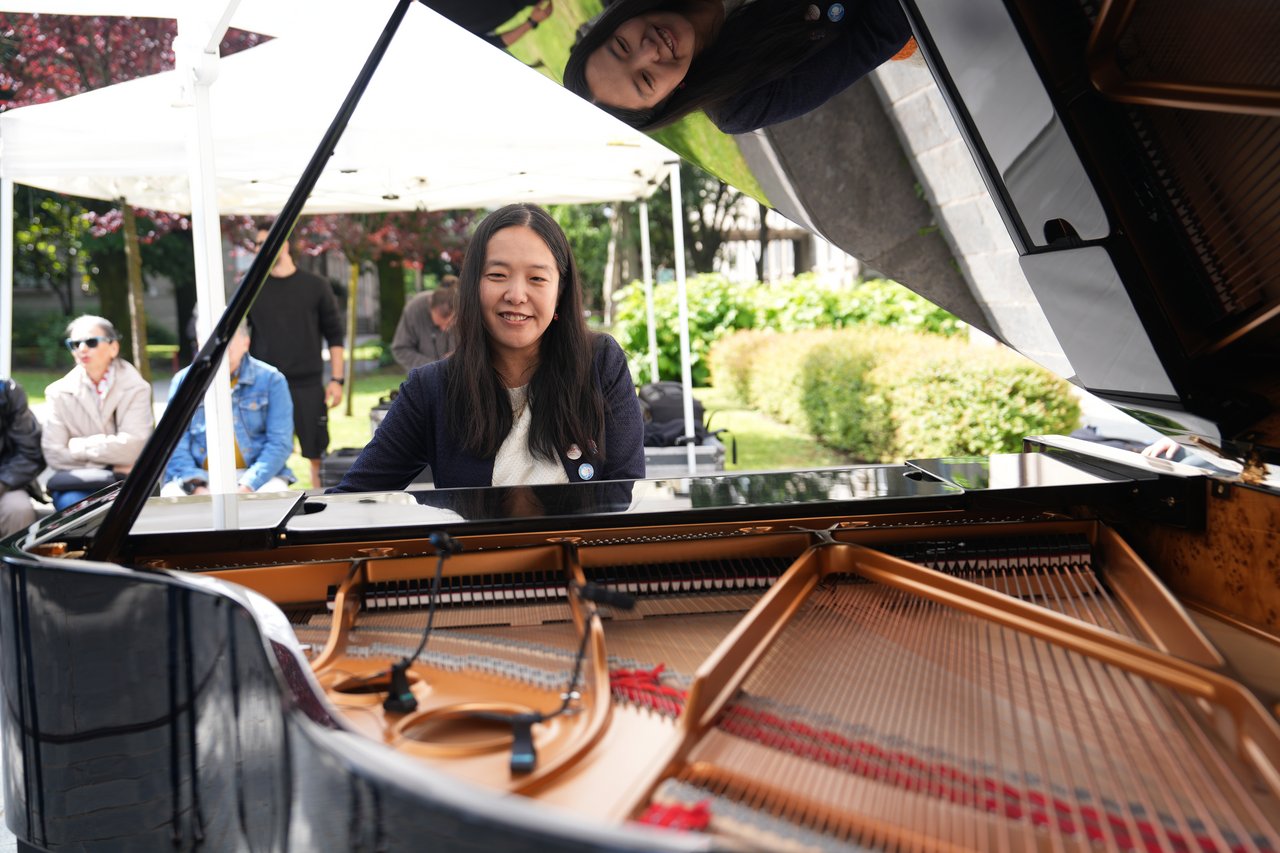
What about your work at the Jellyfish Pavilion at the Expo 2026 Osaka? It was focused on inclusion, too.
I was the producer. Our mission was, and is, to democratize creativity: it means to make the society welcome people more, and people with different backgrounds and problems. What we were trying to do was to have a very enjoyable and inclusive playground, where people can experience diversity. The jellyfish is a symbol of the creativity and life that exist within every one of us, a representation of what cannot always be explained in words: a spirit of “play within your flow”. Through playful experiences, engaging all five senses, the Pavilion aimed to spark the courage to take a new step forward, to nurture confidence and joy in discovering that each of us can co-create a fragment of our shared future. The thematic project “Invigorating Lives” tried to launch a great transformation in how we learn, play, create, and live, bringing together people of every age from 0 to 120 but also those who cannot see or with low-vision, those who cannot hear or are hard of hearing, those who use wheelchairs, those unable to leave the hospital, those who struggle to express themselves in words, people of every nationality, ethnicity, gender, role, and personality. All are mixed together toward a future society where diverse life shines. Because just saying that diversity is important isn’t enough: it's better to create a space where people can enjoy it, and experience it directly. For example, right now with the Kurage Band we’re on a tour through different countries and every day we’re astonished with the tremendous cultures we encounter, getting to know different people bringing us new perspectives. And it’s the same when meeting people who cannot see nor hear: I find it interesting because when interacting with them, it makes me focus on other senses which we usually forget about in our daily life, so busy and stressful. Such an interaction is helpful for everyone involved, and helps to reciprocally acknowledge and respect our different selves. For those who are struggling as a minority, it can be really hard sometimes. I think that in the 21st century, we need to find more creative ways in order to have more personalized points of view in our society, and minorities can have a very meaningful voice that needs to be listened to.
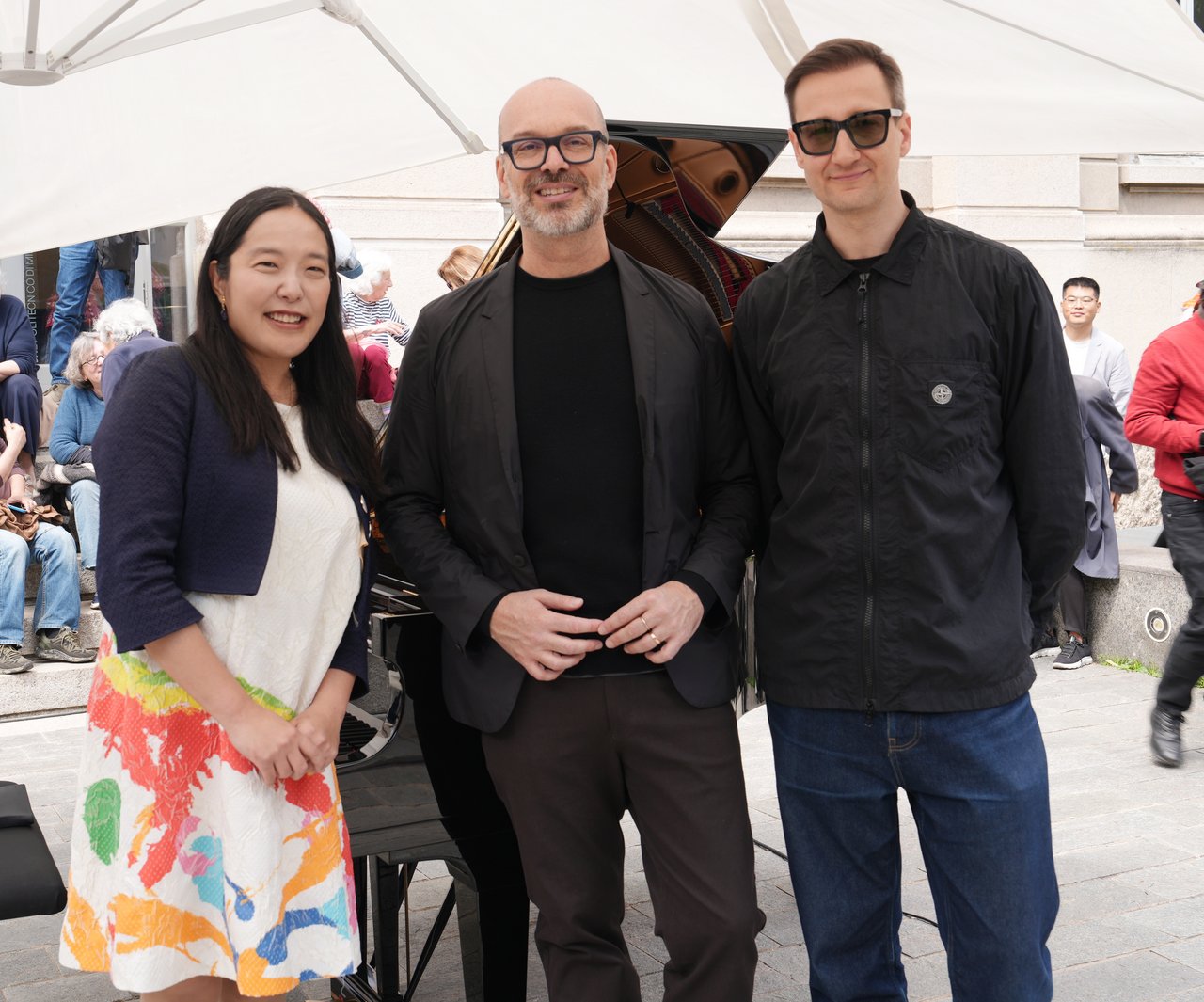
It strikes me that you are both a musician and a mathematician. When did your passion for mathematics begin, and what are the aspects of it that most fascinate you?
In my elementary school days, I was really more into music. I began playing the piano at 4. Then, when I was 14, all of a sudden I stopped playing: I was really interested in composing music, but I realized that my compositions were too similar to each other. So I thought that I needed more life experience to compose better music, and I quit momentarily. At that time, I had a lot of free time and I started to devote myself to literature, philosophy – and mathematics. Once I found myself dealing with one problem for a month, spending all day, all night, just to think about that problem only and how to solve it. That means I also failed many times to solve it, and still, it was very interesting because I tried one way, then another, but I felt a kind of instinct that I was getting closer to something important. And all of a sudden, an idea came up and I could solve it – after one month! It really affected me. I also came across a book by Russian mathematician Ivan Matveyevich Vinogradov, “Three Primes Theorem”: there were three problems shown, and they were quite elementary problems for which you don't have to know any “professional” mathematical concepts. And yet, they’re really difficult: but elementary doesn't mean easy! In order to understand one problem's solution, I spent, again, maybe one or two months. And gradually, I began to feel the beauty of mathematics: it’s not about calculating or being quick in solving something, but it's more like getting deeper and deeper, and feeling the essence of something. You learn how to see a problem with a different eye. When I was 15, I competed for the first time at the Mathematical Olympiad, but I couldn't pass the final exam. Then I went to a specialized summer camp afterwards, a fascinating and formative experience for me. The next year, when I was in the first grade of high school, at 16 I won the first place in the Japanese Mathematical Olympiad. And I was selected to be one of the members representing the country at the International Mathematical Olympiad.
In a certain way, mathematics opened the doors of the world to you!
Yes! In 1996 I went to India for the International Mathematical Olympiad and won the gold medal. Then next year, in 1997, I went to Argentina and won the silver medal. It was a great challenge, I really got excited to go and see the world, different cultures. That’s when my motivation to music restarted. After getting into university, I set to play music again and started to know the world more. After graduating in Mathematics, I decided to go deeper into jazz and just thought about playing for a while. And then, again, at some point I went back to mathematics. It’s really a creative world, I think.
So that could be the link with music…
Creativity, yes! It's not just about seeing a fact with a very solid logic. Mathematics is more about being creative and seeing the world from a different perspective, which could be the most essential perspective. But there's no unique answer, there could be many ways and solutions – that's what I feel as really, really interesting in mathematics!
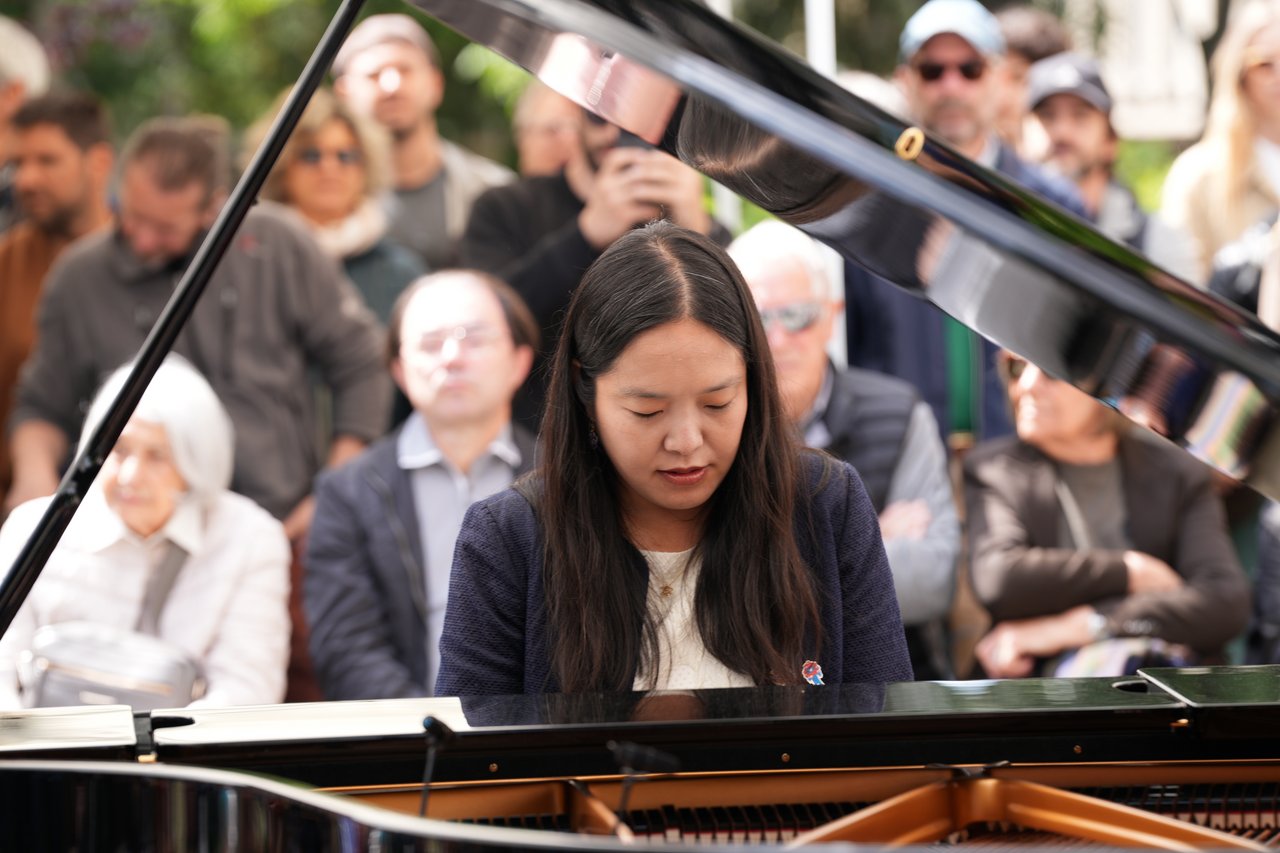
What kind of music genres are you more into?
At first I started with jazz, rock, but I always thought that primitive folk music is at the core of a human being. As in mathematics, especially in jazz there's no unique answer. But I got interested in more primitive music because it doesn't follow the rules such as do-re-mi… It's more generative and essential. It's very different from what you do on stage as a professional musician, in order to earn a living. Everyone has a sense of music and it could be very generative, and by hearing, sensing, we are co-existing and co-creating. When speaking, it’s not possible to overlap voices, but you can do that in music: I play something, you play something, and all together we can be the harmony, also a chaotic one. That’s why I came closer to folk music, recently. For me, mathematics and music are both creative and free worlds everyone can inhabit, and by resonating with each other we can build something new together. It's the most intriguing part about both of them.
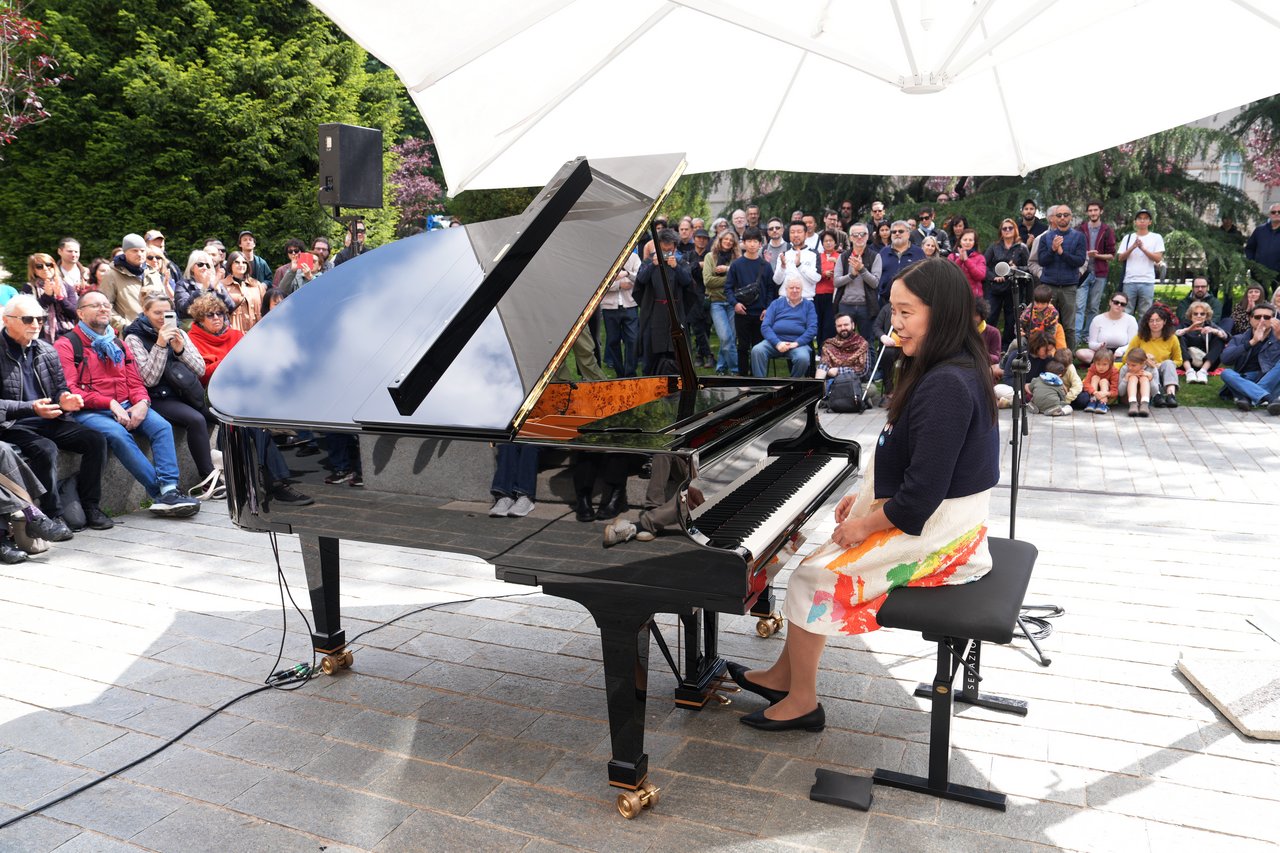
Do you think that mathematics can help you being a better composer, in some way?
Yes, actually mathematical backgrounds may help composing in a different, more structured way. Though when I compose a good piece, for me, it's more an intuitive process, like something that happens and pass down through my body. But I think one needs both logic and senses. In mathematics, you really need emotions or instinct in order to perceive a new way to see things, hidden, essential points of view. Sometimes it can really help to relax, go to the mountain and enjoy yourself, to be able to look at things from another perspective. And for music it’s the same, senses are important but can be a limit too: for babies, everything is very new and innovative but, for adults, gradually as you grow up you’re surrounded by lots of bias. At that point, again, logic can help you to think out of the box and to free your thoughts. Sometimes, when I'm stuck with composing a new type of music, I stop and try to analyze and gradually I see the way out through logical thinking, sorting out different solutions. So I definitely think that both sides, senses and logics, inside and outside of our body, right brain and left brain, should really be integrated in order to produce something new.
Leibniz, the philosopher, said that “music is a secret exercise of the soul, arithmetic that counts without even knowing it”. He conceived music as a series of numerical ratios and proportions. Do you share this vision?
Music has various mathematical aspects. I really love famed mathematician James Joseph Sylvester’s definition that “mathematics is the music of reason”. There’s a way of composing based on mathematical series... For example, Bach used mathematics so much, and also improvised with mathematical structure with beautiful results. But even in very primitive music and instruments there’s mathematics, and to people it can sound beautiful, although chaotic. But still, when we’re feeling something physical, as we know that physical things are based on some kind of mathematics or biology too, maybe then we’re using our senses to understand an inner mathematical structure. When listening to music, we’re not only using the brain, but also our body, our senses to understand its mathematics. If you enjoy a beautiful melody, birds singing, or a composition by Bach, it's like in a way you're perceiving a sort of inner harmonious structure that triggers something into you: people are feeling mathematics actually, and it can influence their emotions.
Being trained with music can help shape the brain in a certain way, that can make it more inclined to mathematics?
Yes, by listening to and enjoying or playing music, I think that helps you understand more about mathematics or science. In any type of music, you can actually train yourself to feel the structure of the inherent harmony of the universe. Many mathematicians love music, and many musicians love mathematics too.
You mentioned jazz, rock, folk music, but which were the major influences on you as an artist?
Actually, my sole mentor is Takehiro Honda (1945-2006), a great Japanese pianist. Of course there are many others I love, like Keith Jarrett or Jimi Hendrix, but for my life Takehiro was really one of the biggest inspirations: I decided to make music for all my life thanks to him, after I heard him playing. By then, he had had a brain stroke twice: doctors told him he couldn’t play the piano anymore, because the left side of his body wasn’t moving. Before the incident, he was very famous but maybe a bit arrogant, living a wild life. At the hospital, he begged them to let him play and practice, as there was a piano there. At first, his hand couldn’t almost move: but he started anyway, and gradually, slowly his left hand began to move, move, move. He practiced all day long, until he started to fully play the piano again: the first song he could actually play was a Japanese soulful folk song, a baby's song. I think he learnt a lesson there, because he was almost dying. His music had a power on me, people say that his piano was better before, but for me it was far better afterwards: I heard him playing that song, and it really moved my and other people's hearts, because there was a melancholy about it. It's not just the music, it's the story of his life that was such a great inspiration to me.
Here at Politecnico di Milano we have an orchestra, Polifonia, made by pupils who are at the same time studying engineering and also playing music. Could you give them an advice about how to pursue both careers? Or how one can help the other?
Nowadays, I think that we cannot define ourselves anymore only by one career. You are you, don’t compare yourself with others and make something new: you can create your own life career. Because also for being a good engineer, just studying isn’t enough. Music, your passions, can be creatively integrated into your career. For example, I sometimes put mathematics on hold, or sometimes I stopped making music. But now I keep on doing both – so if you like something, just keep on doing it. If you feel tired, maybe it’s just because it’s not the right time and you can stop for a while, and then restart again any time. It's definitely possible to pursue different careers and passions.
You might also like

Geopolitical instability, health crises: the risks in the pharmaceutical supply chain, and how to manage them

From circuit to laboratory
The collaboration with the Politecnico as seen by Autodromo Nazionale Monza

Research Takes to the Track at Monza
The agreement between Politecnico di Milano and the Monza National Circuit creates an open-air laboratory for safety, sustainability, materials, mobility and major events.

Compostable, edible, made from apples: the label that reduces the environmental impact of food packaging
Italia di mezzo, the research that places the Italian province at the centre
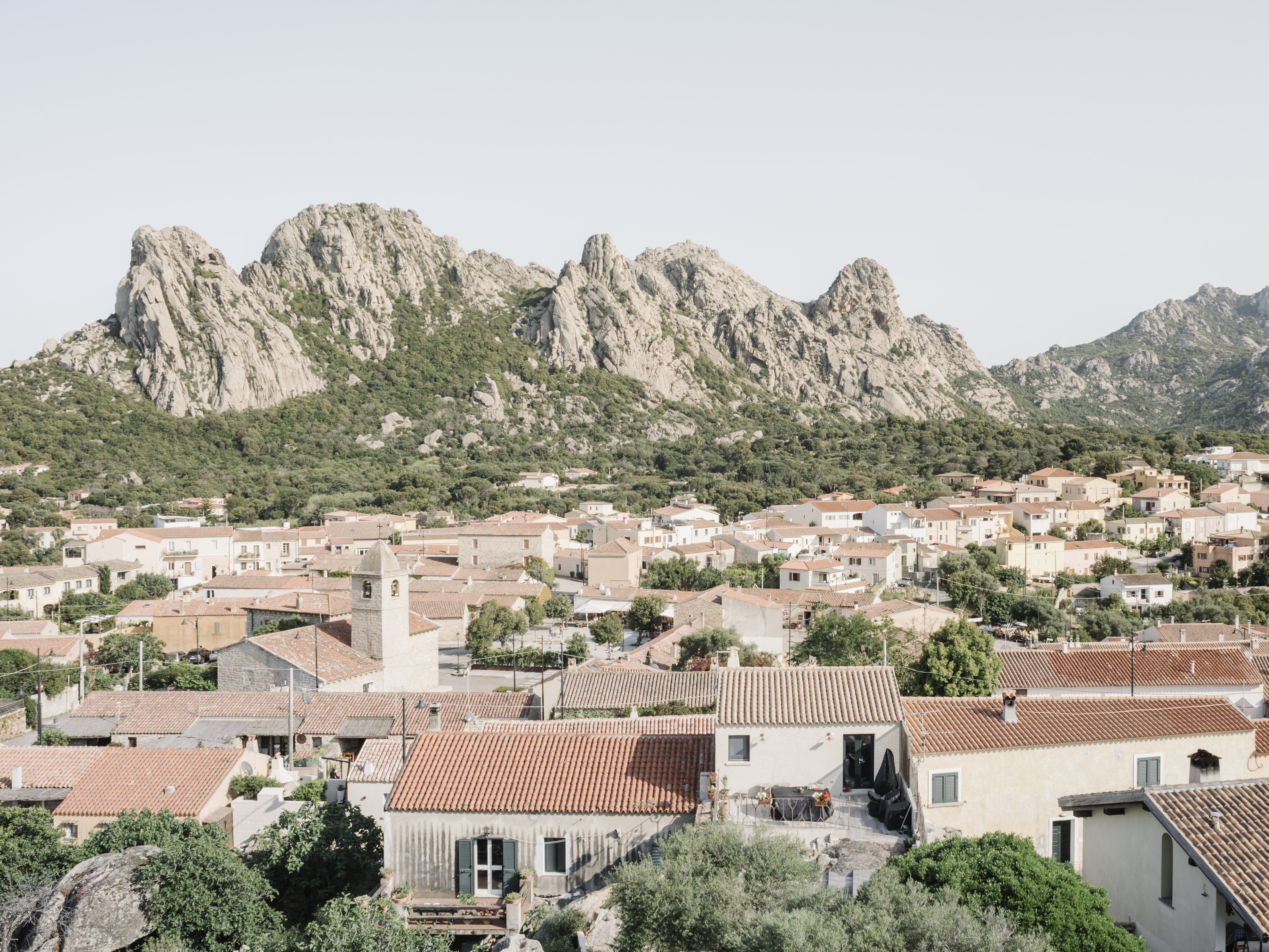
The DAStU project studies territories that coincide neither with large metropolitan areas nor with inner areas, and seeks to build new representations to support their socio-ecological transition