
 by
by 
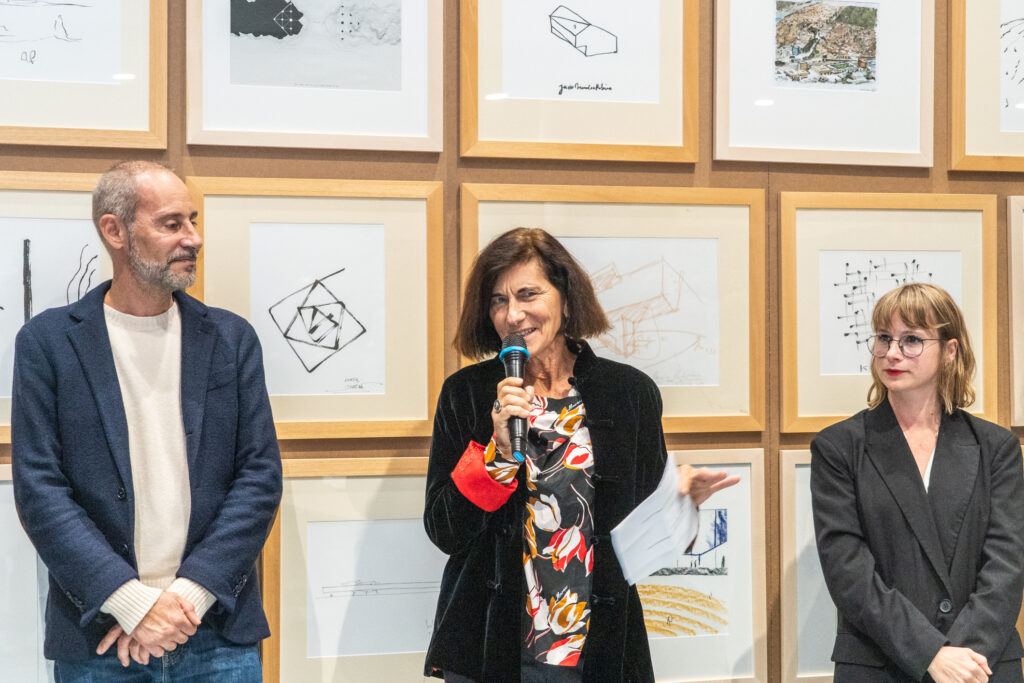
After the interview with the Deputy Rector Emilio Faroldi and his assistant Elisa Boeri, the voice of Emanuela Bergomi paints an intimate and vivid portrait of her husband Federico Bucci, the rigorous scholar, the curious traveller, the ironic father, the man capable of transforming every encounter into a story. From living a life together in the studio to everyday family life, from travel to shared passions, to the excitement of the exhibition The Future is in History, which celebrates his cultural legacy, we find a memory of deep understanding based on books, architecture, cultured details, and domestic rituals. A sincere, affectionate fresco, charged with the typical dynamic approach Federico had to being part of this world.
Were there times when you and Federico worked together?
Yes, of course. After our marriage, we established a studio where we developed editorial projects together. Federico also followed the “Quaderni del Dipartimento di Progettazione dell’Architettura” published by Politecnico. I managed administrative activities, as well as archival and iconographic research. This worked out well for a while. Then he went into a more structured collaboration with the Politecnico, and I found another job.
Did you have common habits or passions outside work?
Very few, outside architecture. Travelling was our great passion. Our trips always focused on exploring cities, rarely considering nature, in which he had little interest. Only when our son was little did we spend some time in the mountains, in South Tyrol, for three years in a row. Travel and photography were our common activities. I took pictures on the first trips with a camera my father had given me. Then he got into it too. Sports were never something we did together. He played soccer, and later tennis, whereas I played something else. At times we would ski together, that was it. We also loved going to the cinema and to the theatre.
How did he reconcile all his commitments with family life?
Over the past few years, family life had inevitably become more limited, given the many commitments of the role he held. He just needed to relax at home. Over time I adjusted. I understood that it was complicated. When we were young, we used to go out a lot, but then it became increasingly difficult. We recently got a house on Lake Garda. He really enjoyed taking a rest from work there. He had his own little studio overlooking the lake. He played tennis, enjoyed a reviving swim, and even running. That was his genuine moment of peace.
Did he read a lot?
Very much. We both loved reading, but he was a tireless reader. There were times when he wanted me to read certain books before him, so I could recommend them to him. There are hundreds of books in the house on architecture, philosophy, history, literature, and art. When we were young, it was a pleasure to browse through second-hand book stalls, collecting books that were often impossible to find. It was a passion that created a strong bond between us.
Are there any anecdotes or family jokes about him?
Yes, there are many. He got on very well with the family. He told us jokes and stories, leaped out of his chair if my relations had not heard of renowned architects, such as the French Ledoux and Boullée, and lectured about them over a meal. He was always the most awaited guest at gatherings as one was never bored with him.
He had a funny ritual with our son Lorenzo. At dinner he would ask about the day’s lectures, and receive an ironical response. It had become a regular occurrence. When Lorenzo enrolled in Engineering, they started telling each other amusing anecdotes about architects and engineers, joking about their respective fields of study.
He was more practical with me. He never asked about my work. He wanted to know about what I would cook for dinner, or what movies we would watch together in the evening. I prepared the list so we could rapidly choose one.
He loved socially committed movie directors – Sorrentino, Iñárritu, Moretti, Bertolucci – but he really relaxed watching action movies with Lorenzo, such as “Fast & Furious”, “Mission Impossible” and the like… He was a very ironic and sociable person. He was very entertaining with friends or with boys. He was a fun and engaging father. When at home, he did not speak much about his work. He only talked about important clashes and quarrels, or generally about his commitments.
Did he leave you a piece of advice or a phrase?
I would say there are two in particular. The first is, “Never complain”. Of late, he repeated it often. Avoid pointless, passive complaints, if you have no intention of actively changing things.
The second concerns “historicising”. He said that, if you want to really understand an event, even a personal one, you should read its timeline, referring to history. He taught me that one cannot judge anything in the moment it happens, because only historical distance endows events with meaning.
Did he apply this vision in daily life?
Yes, absolutely. Even on trips, when visiting places or cities, he had this ability to “feel” that we were approaching an important building or work of art. He would say, “I smell a masterpiece”.
He was curious and friendly. While travelling, he would always attract people’s attention, and end up making friends with everyone. He had a magnetic smile.
He was curious and very cultured, wasn’t he?
Of course. Nothing escaped him. He was curious about everything, and very resolute. He would not give up until he understood something. I remember that when our son Lorenzo told him that the spectacles Persol came from the Italian phrase “for the sun”, and had been specifically designed for tram drivers in Turin, he was almost annoyed that he didn’t already know that, as he usually knew everything.He also loved being with people, chatting with anyone.
In Garda, for example, he found a barber with whom he spent long hours talking. Then he would go to the village fisherman to hear about the various types of fish, or he would talk to anyone he met.
He picked up something – a detail, a phrase, a story – from every person, from every little encounter. He was a curious observer, a collector of fragments of life, ever open to absorb everything around him.
He had a tendency to empathise with the situations and people he encountered.
Yes, always. He had a natural skill to empathise, to immerse himself into situations, even the most everyday ones. In Favignana, for instance, he would speak in Sicilian with the fishermen, discussing mussels and the sea. Nobody would have guessed that he was a university professor. He liked stepping into the characters, blending in with the environment. A sort of Zelig.
The same happened in South Tyrol. There he would suddenly become an expert on mountains, on paths, on alpine pastures. He possessed an almost theatrical nature.
What about his passion for soccer?
He was a die-hard fan of the club Inter. That was a real nightmare. He never missed a game, even if he had important commitments. But he enjoyed himself like a child, with the same naive passion as always.
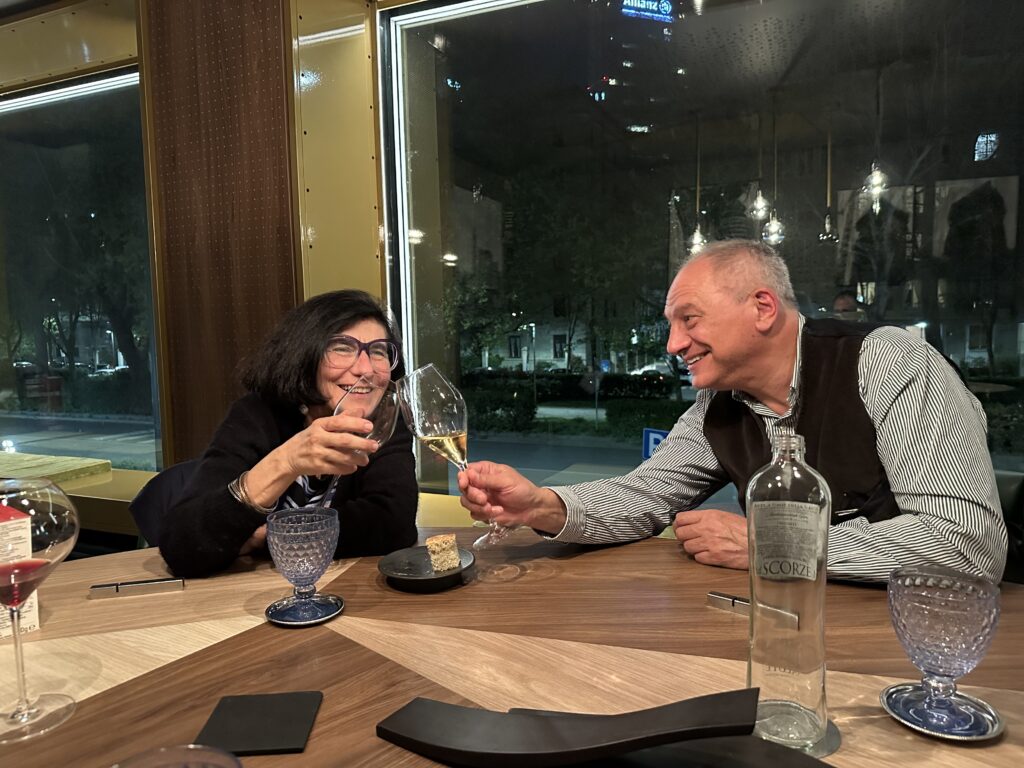
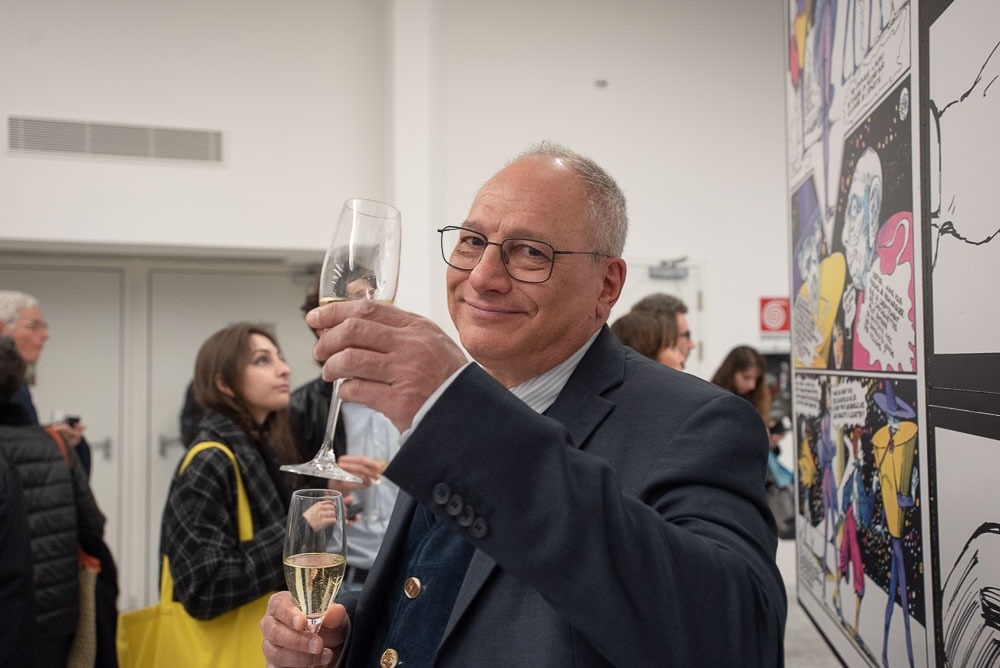
He also had a little ritual. He only drank champagne at parties and celebrations “because everything else is bad for me”, he would say. It turned into a family tradition.
And now, with the exhibition The Future is in History you have collected many memories, books, photographs, dedications by famous artists.
It has been an important and extremely enlightening experience. I worked with Federico’s colleagues Lola Ottolini, Filippo Bricolo and Emilio Faroldi, and above all with Elisa Boeri and Luca Cardani, his academic heirs, who conceived this exhibition. Collecting photos and picking up all the books written over the years carried me back in time to relive journeys, events, and adventures experienced with our son Lorenzo. It has been an intense moment. Renzo Piano joined us by sharing a moving memory of him, «The rigorous scholar and the man of ideas coexisted in him, the guardian of memory and the tireless promoter of new perspectives. History, for him, was living matter, to be questioned, to be renewed, to be projected into tomorrow. He had the rare gift of knowing how to listen, turning every encounter into an opportunity for growth. His energy, curiosity and belief in the value of culture remain a valuable legacy for those who had the good fortune of knowing him, and of working with him».