

900 tests in the wind tunnel for the cycling world champion TOP GANNA

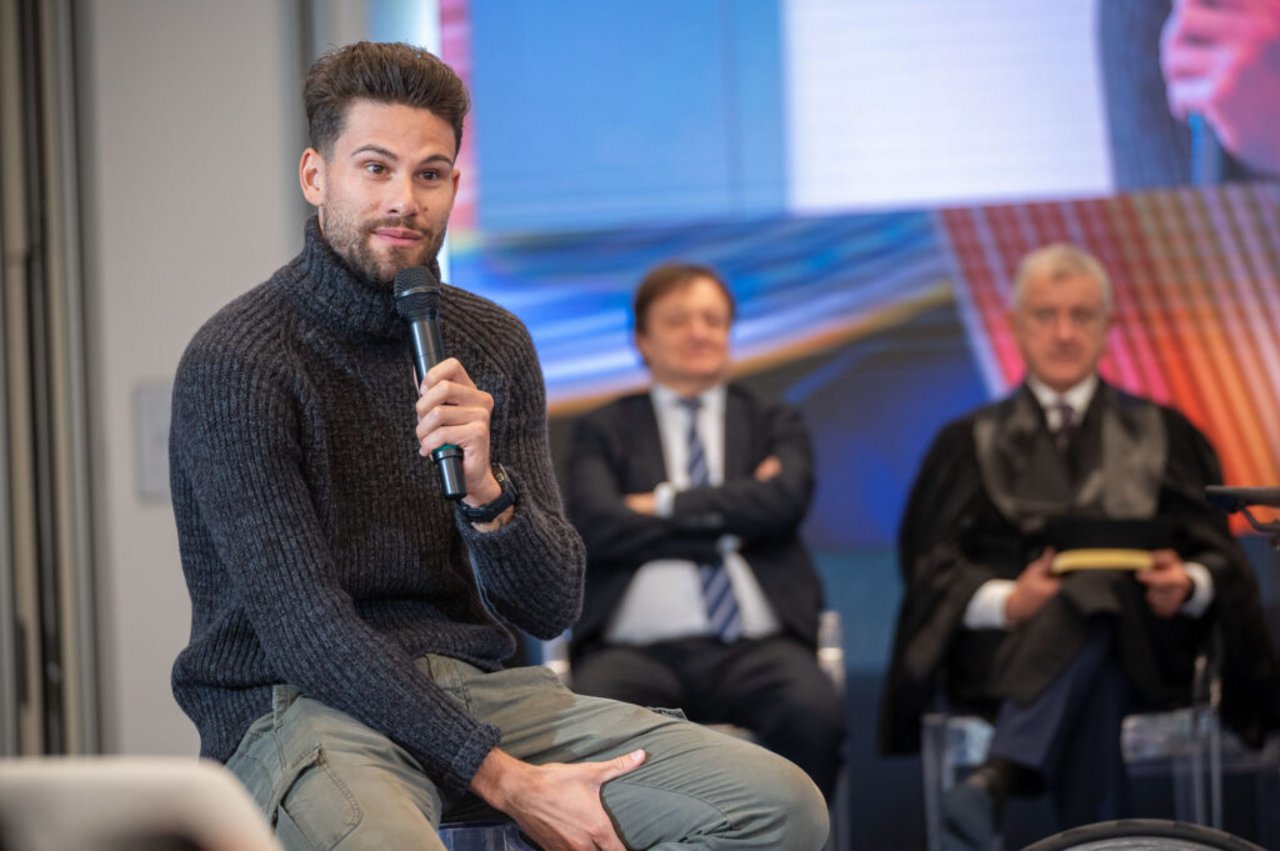
Filippo Ganna at the Opening Ceremony for the 162nd Academic Year at Politecnico di Milano photo by Matteo Bergamini, © Lab Immagine Design POLIMI
Twenty-eight-year-old Filippo Ganna from Verbania in Piemonte is everyone’s TOP GANNA. At a height of 1 metre 93, and a weight of 85 kg, he’s definitely a man of records: a champion at the Paris 2024 Olympics, winning a silver medal in the men’s individual road cycling time trial and a bronze in the team pursuit; holder of the world record on the track (56,792 km); two-times world champion for the road time trial; six times world champion for the individual pursuit (in 2016, 2018, 2019, 2020, 2022 and 2023), a speciality for which he held the world record; and also world champion in 2021 with the four-member team pursuit; plus winner of seven stages in the Giro d ‘Italia.
We exchanged a few words with him when he was guest of honour at the Opening Ceremony for the 162nd Academic Year, an event entirely dedicated to sport. He stressed how important technology and research are in improving sporting performance, citing the tests carried out in the Wind Tunnel in Bovisa, which played a decisive role in how he performed. He’s a modest, reserved individual, with a wide, genuine smile, excited to be speaking in front of the professors at the Politecnico, but also happy to sign autographs and pose in selfies.
How can you achieve similar results both on the track and the road so soon after winning two Olympic medals in Paris?
In the end, what matters is your dedication, as in any area of work or study. And then there’s your passion, which enables you to go beyond where your strength alone would take you; and there’s your head too, what I call your competitive training, because in the end, when you’re in the race and you’re bent on winning, there’s no middle way. So, many results are achieved with dedication and passion, and also with all the tests we have behind us, and with teamwork.
How much is about your head, and how much about training?
Ultimately, the head may well play the most important part, because when things are not going well, when the results aren’t coming, when you’re not feeling like you do on your best days, you want to stop instead of moving forward. The head rules everything, so a lot of it relies on training, but your mental attitude is equally important.

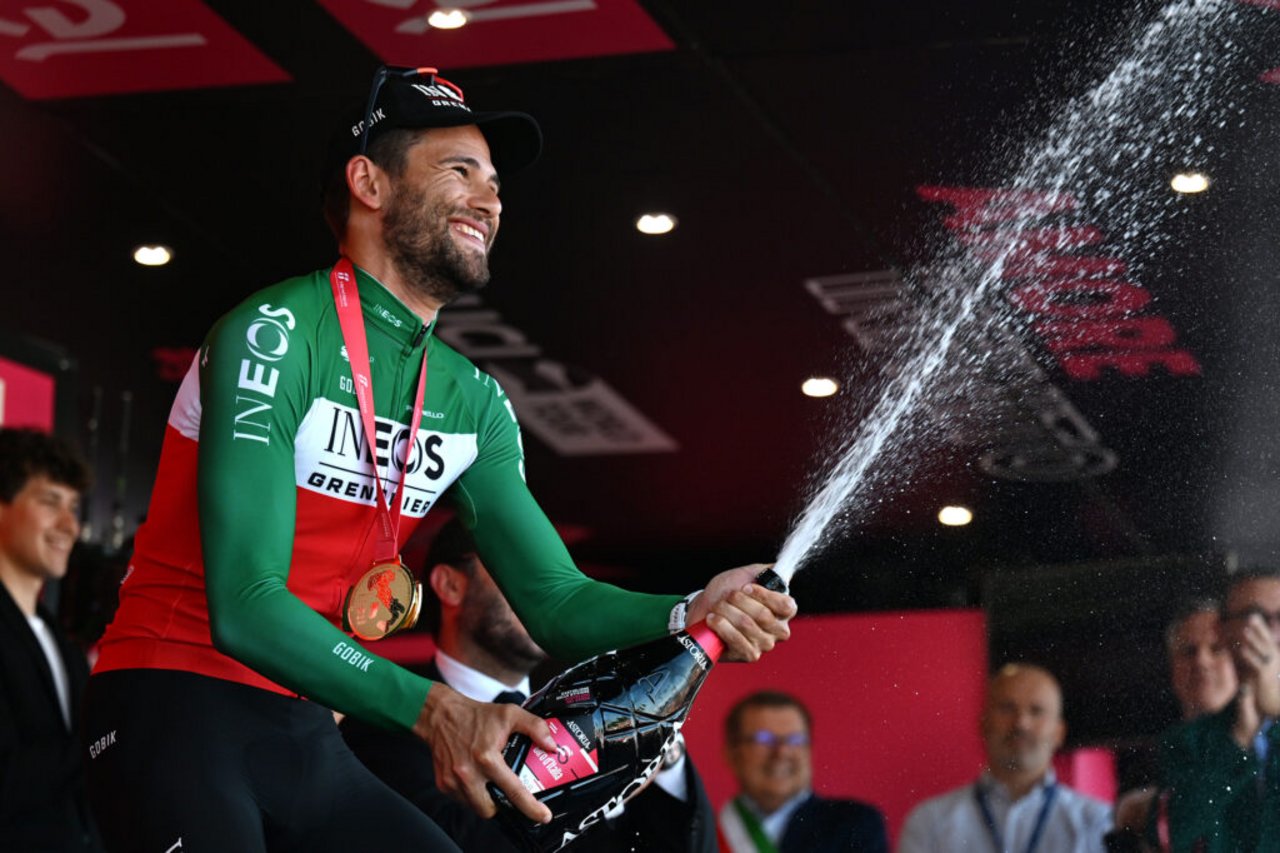
Saarbrucken, Germania – 25 agosto 2024 Filippo Ganna del Team INEOS Grenadiers durante il 39° Giro di Germania 2024
(Photo by Christian Kaspar-Bartke/Getty Images)
There are times when you only just win or lose, how do you deal psychologically with these sorts of ups and downs?
Yes, in my sport in particular it’s all on a knife’s edge, but you have to accept that in the end, because if you don’t accept it, the defeat can feel worse. However, you know that every defeat motivates you to try and win the next time.
And how important is the team? Your Italian foursome won gold in Tokyo in 2021 for the track cycling team pursuit. With Francesco Lamon, Simone Consonni and Jonathan Milan you set a new world record.
Teamwork on the track is crucial, because all you have to do is get the pace wrong, go too fast or too slow, and you ruin the integrity of the team, and the work you’ve been doing for so many years. I always say, this job should be divided into 25% each. But when you realise that there’s one athlete who can’t give it 25%, then the remaining 5% needs to be divided between the other three, so the balance always has to be carefully calibrated to achieve the result that the group needs for victory.
So it could be up to me once, and then up to you.
Maybe in Tokyo the load was more on my shoulders, but this year in Paris, Johnny (Jonathan Milan) showed that he was in a higher gear than the rest of us. The result was a bit of a let-down for everyone, because obviously from being Olympic champions only getting a bronze medal hurts, but we’re trying to look forward to the next games.
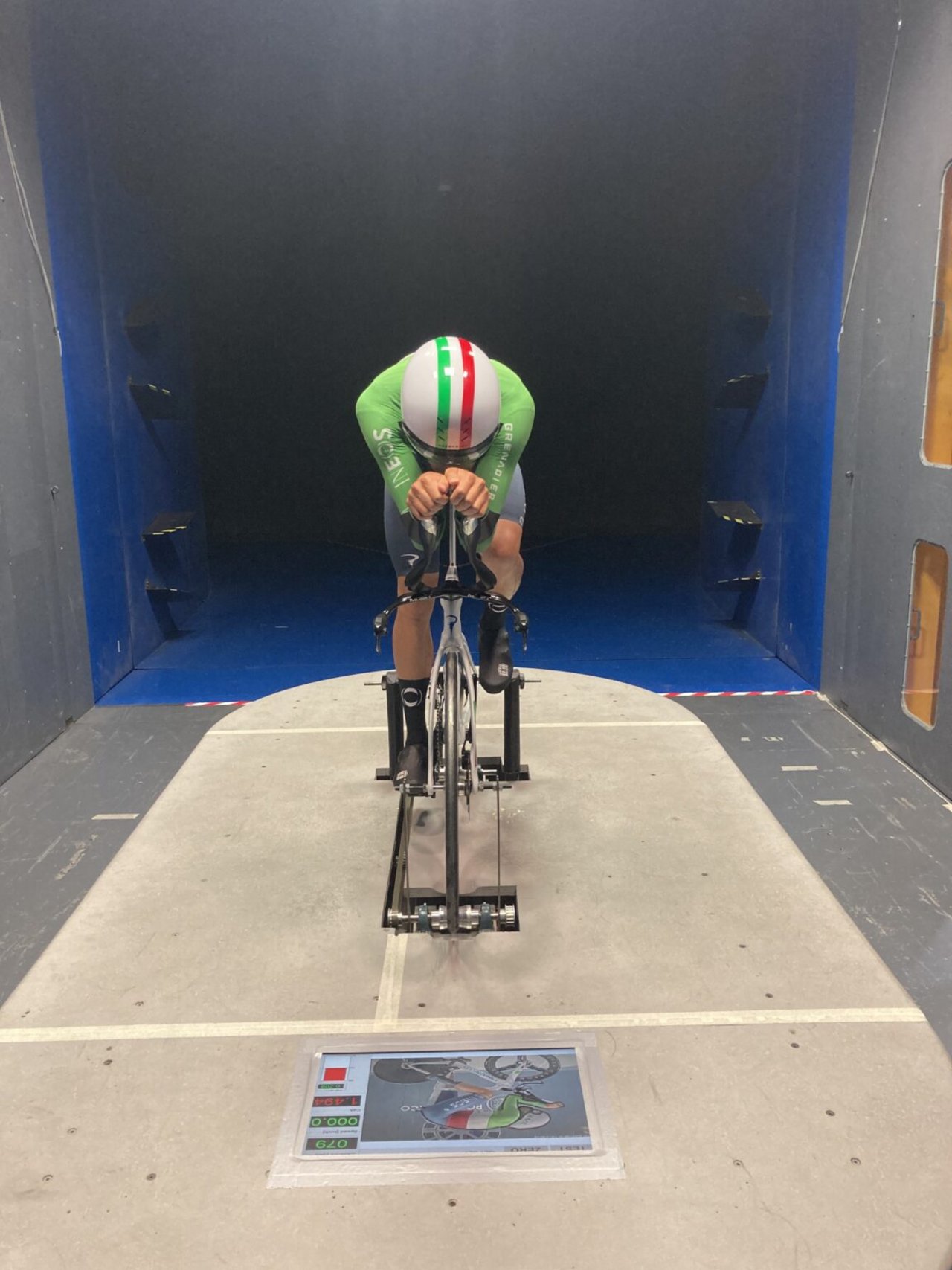
One of Filippo Ganna’s 900 tests in the wind tunnel at Politecnico di Milano – Photo by Dario Cioni
A bronze at the Olympics is still a great result! And we found out today that you’ve done 900 tests in the Wind Tunnel at the Politecnico di Milano in the 10 years since 2014!
Yes, I couldn’t believe I’d done so many of them! Each test involves lots of sessions in which you go in, get into position, set the parameters and feel the wind coming in for 15 minutes. Sometimes I was in there from morning till evening and I even got to do as many as 50 launches. I’ve had the wind in my face for so many years, here on the rollers with my head down! But every test told me whether I was going in the right direction, if I was improving or not.
You’ve tested everything from helmets to clothing, in particular the very special bodysuits for time trials and track pursuit, even socks: how big a factor is the aerodynamic nature of these materials?
Sometimes 1% doesn’t look like much, but it really does change a lot; so even just the way you position your head, higher or lower, more or less bent, or put your hands in one position rather than another, can really gain you a lot of seconds. All the tests we did with the different variables helped to improve my performance. And I have to thank all the technicians of the Department of Mechanical Engineering who’ve dedicated time and energy over recent years to help us to go faster and to excel.
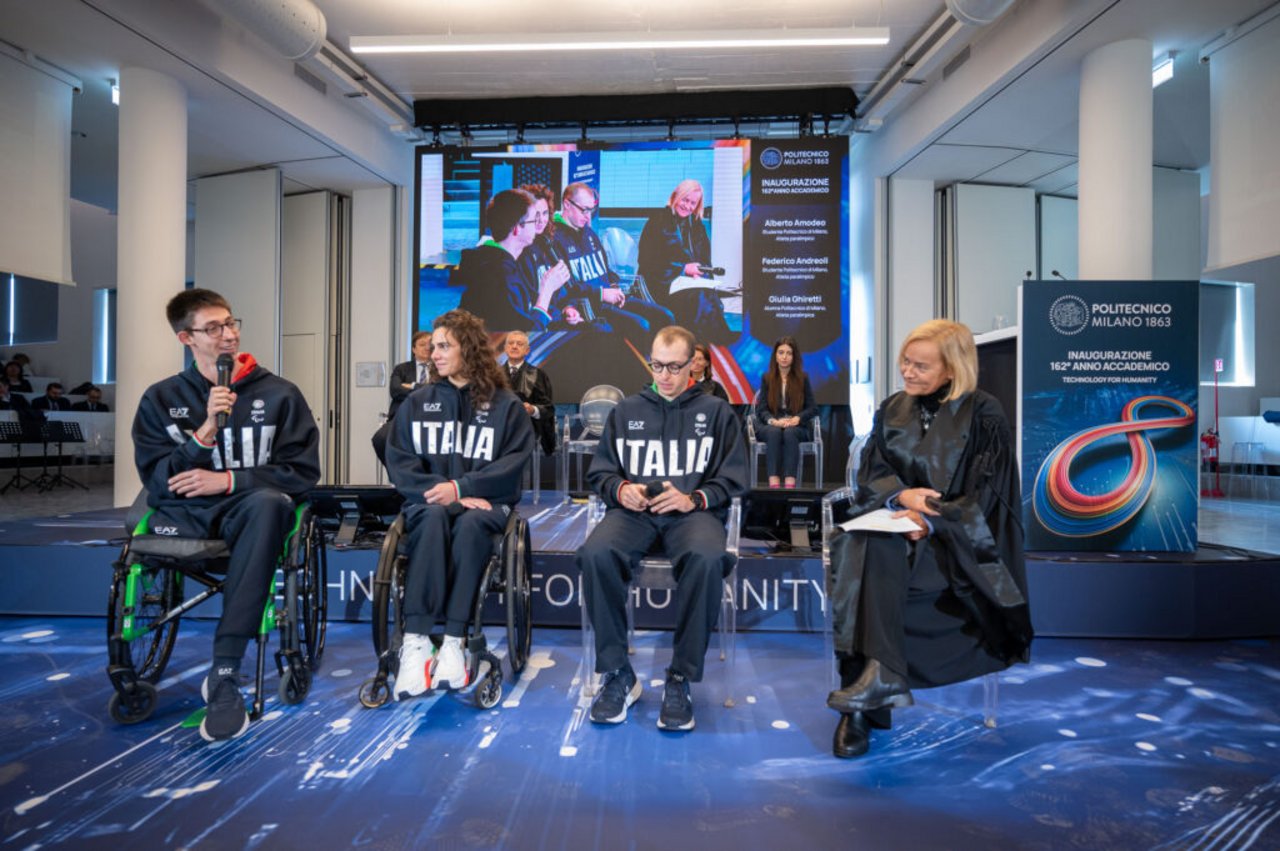
Paralympic athletes: students Alberto Amodeo, Federico Andreoli and Giulia Ghiretti at the Opening Ceremony for the 162nd Academic Year at Politecnico di Milano photo by Matteo Bergamini, © Lab Immagine Design POLIMI
You’ve also met some of our Paralympic athletes at today’s ceremony, how inclusive is the sport?
Very inclusive, because you can now get to the highest levels and achieve the same visibility, which I think is the most important thing. I very much admire these athletes, I think they are an inspiration for us all.
How much has sport enriched you as a person?
On a personal level, it has given me lots of satisfaction and opportunities, surrounded me with friends, and enabled me to travel and get to know new places and new people. Anyway, I see it as a wonderful journey that I am happy to go on, and I know I’ve chosen the right path for my future.
What are your plans for 2025?
There are lots, and mainly I want to get back to winning as in previous years. This year, with all the work for the Olympics, I was more focused on that goal, and may have neglected the start of the season with my team. So, as well as CONI, and the national team, I should also acknowledge the role of society, which has allowed me to come here to Politecnico so many times to learn and improve.
Related stories
Circular Fashion-Tech Lab: where fashion becomes truly circular
Integrating design and advanced technologies from a more sustainable perspective

Inside the World of Graphene: A Conversation with Nobel Laureate Konstantin Novoselov
A journey through discoveries, intuition, and groundbreaking applications

From the reactor to the future: we shall tell you about CESNEF
Safety, knowledge and innovation. This is how the Enrico Fermi Study Centre has transformed nuclear research at the Politecnico di Milano into a permanent laboratory of ideas and skills

How Much Randomness Is There in Jazz Improvisation? Maciej Lewenstein, a Theoretical Physicist, Explains
His research is marked by a multidisciplinary approach and an insatiable curiosity, leading him around the world.

900 tests in the wind tunnel for the cycling world champion TOP GANNA
Interview with Filippo Ganna, Olympic road and track cycling champion.
You might also like
Beyond true and false: recognising synthetic content in the age of AI
From cloned voices to deepfakes, the challenge is no longer just to distinguish what is true from what is false, but to understand how content has been produced, transformed and used.

Who owns Milan? Map reveals forces reshaping the city
The financialization of the real estate market and its effects on urban development dynamics

Technology in the desert: how to map in 3D Egyptian and Roman excavations using photogrammetry
An interview with Alessandro Mandelli, a veteran for Politecnico di Milano's excavations in Egypt

Reading Maps: The Taste of Discovery
Jessica Gritti discusses the research on the Maps section of the Civica Raccolta delle Stampe “Achille Bertarelli”: from cataloguing and new international connections to the value of collaboration between universities and cultural institutions.
