

 by
by The basement of building 14, on the Politecnico di Milano’s Leonardo campus, hosts a lab that is unique in Italy, the TEXTILES HUB. Textiles and their applications in the construction system are studied in a small two-storey building with a textile façade.
Maria Giovanna Di Bitonto, who graduated from the Politecnico and carried out her PhD programme in this lab, studying textiles that retain water from fog and their uses on a large scale, tells us «It is an inter-departmental lab, which is part of the Department of Architecture, Built Environment and Construction Engineering. Design, Energy, Chemistry and Mechanics belong to it. The lab is headed by Professor Alessandra Zanelli.
In addition to academic research, TEXTILES HUB also conducts research in collaboration with private manufacturers or installers who request to have their fabrics tested.

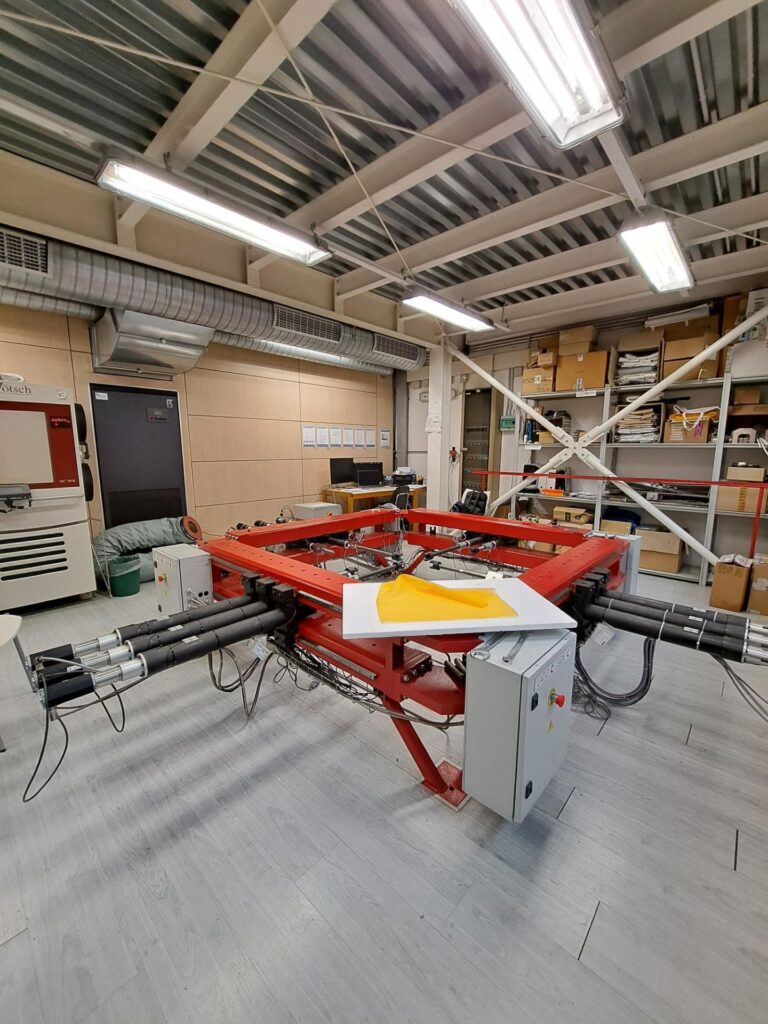
The laboratory’s flagship instrument is a biaxial machine used to measure and evaluate the elasticity of fabrics and their breaking points on the two axes of weft and warp. It has three actuators on each side (the black tubes in the photo), which pull the fabric independently of each other. The machine is extremely adaptable: it can study samples of different sizes and materials, which are also used in very different contexts, from construction to coatings. It is used with a climatic chamber, which allows specific climatic conditions to be simulated, controlling, for example, temperature, lighting, and humidity. The climatic chamber therefore allows years of environmental exposure to be simulated in a short time and under repeatable conditions.
Hence, the lab specialises in research on the use of textiles in the construction and architectural scene. It is nothing new, says Ms. Di Bitonto, because records of this application date back to the Roman Empire. Textiles found a new use when plastics were introduced during World War II.
One of the main applications is on building façades, particularly on glass skyscrapers, which need shading systems for both visual and thermal comfort. Indeed, sunlight reflected by glass heats the environment, and is brighter than tolerable to the human eye. Textiles can be used to clad these buildings by creating an ultra-lightweight system that virtually any building can support. It can be easily applied to either existing or new buildings.
The cladding is like a second skin.
This type of transparent and very thin membranes is much lighter than glass. It is often used to cover large span roofs such as stadiums. We see such an example at the Watercube in Beijing, an aquatic centre built for the 2008 Olympics with a pneumatic façade made of two layers of transparent textiles pumped with air. The structure is much lighter than glass.
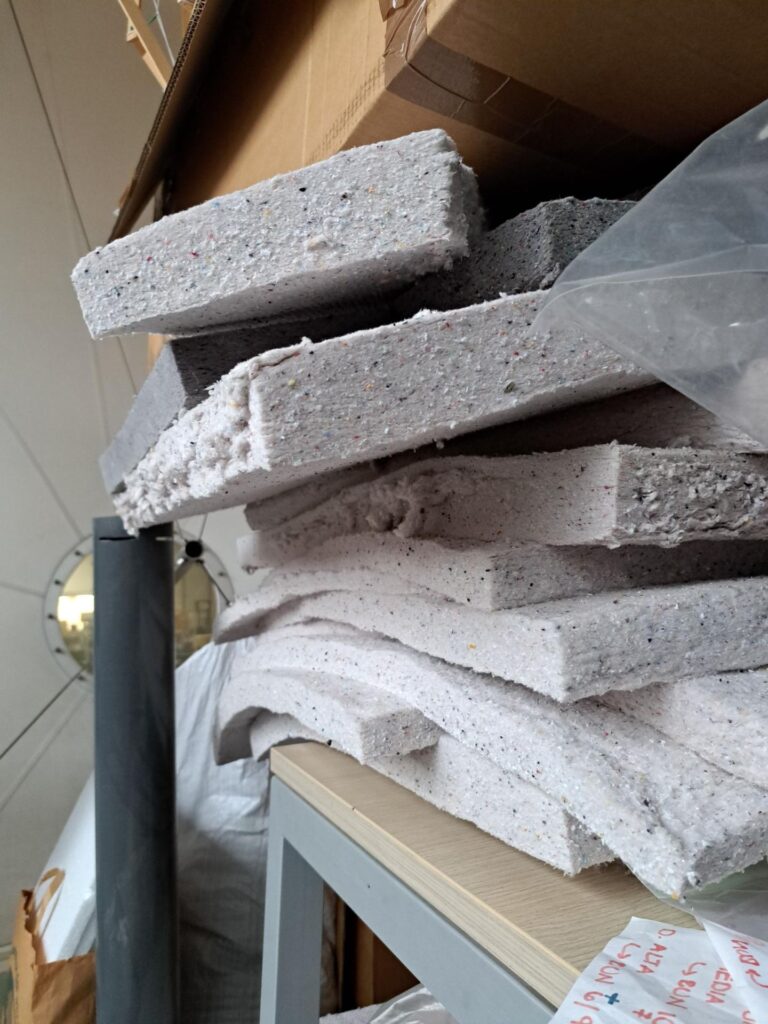
Textiles can also be used as insulation material. The lab tested the process through a partnership with Humana, which provided waste clothing from which textile panels were compressed together with varying degrees of density. «This is how things work at times. We have a source material, and we study it to understand how it can be used,» says Ms. Di Bitonto. «At other times, it is the reverse. We have to achieve a goal and, therefore, we look for the right material».
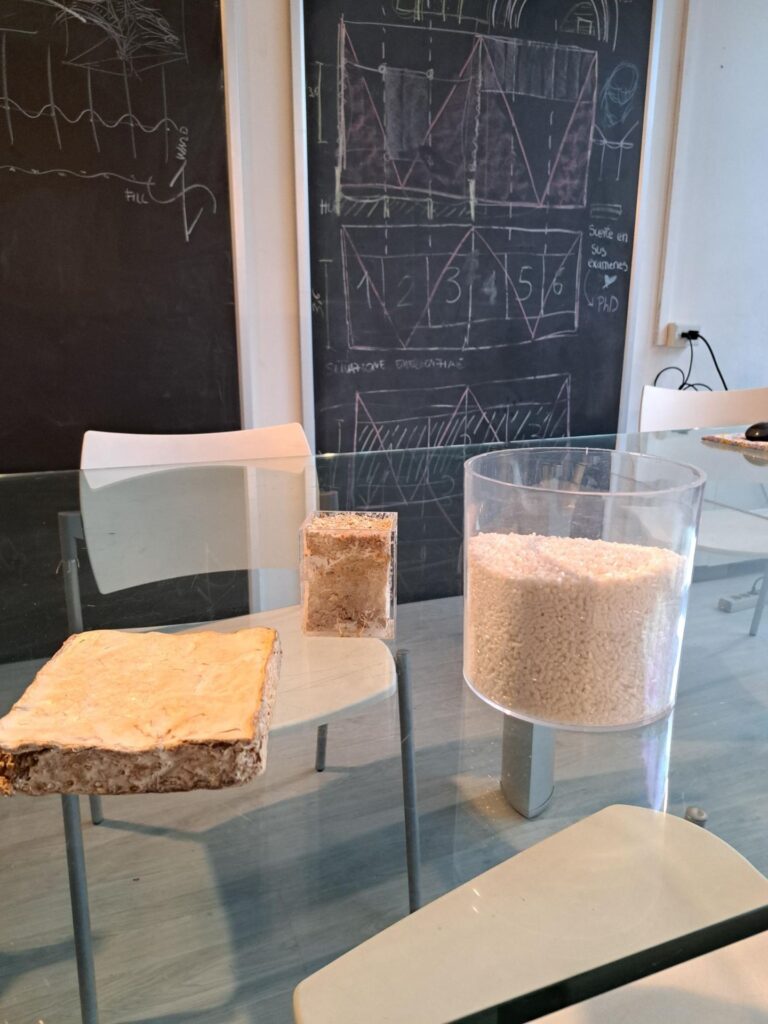
TEXTILES HUB conducts experiments on various materials: polymers, natural fibers, and mycelium, to name a few.
Three professors (Alessandra Zanelli, Carol Monticelli, and Salvatore Viscuso) work in the laboratory, together with Di Bitonto and a group of doctoral students, all with architectural training and each with their own thesis and micro-sector of reference, from mushroom panels to photovoltaics spread on fabrics, from studies on fog to applications for passive houses.
While spending a study period in Chile, Ms. Di Bitonto, in particular, discovered («I discovered something they already knew,» she says, laughing) the pre-Columbian technology of capturing water from fog through textiles. These were fishing nets for the most ancient populations, and are atrapanieblas for the moderns, a life-saver for those who live in arid territories but are still touched by the cold currents of the seas and oceans.
During my PhD research, which I carried out in this very lab, I identified more effective textiles, which can replace those in use today.
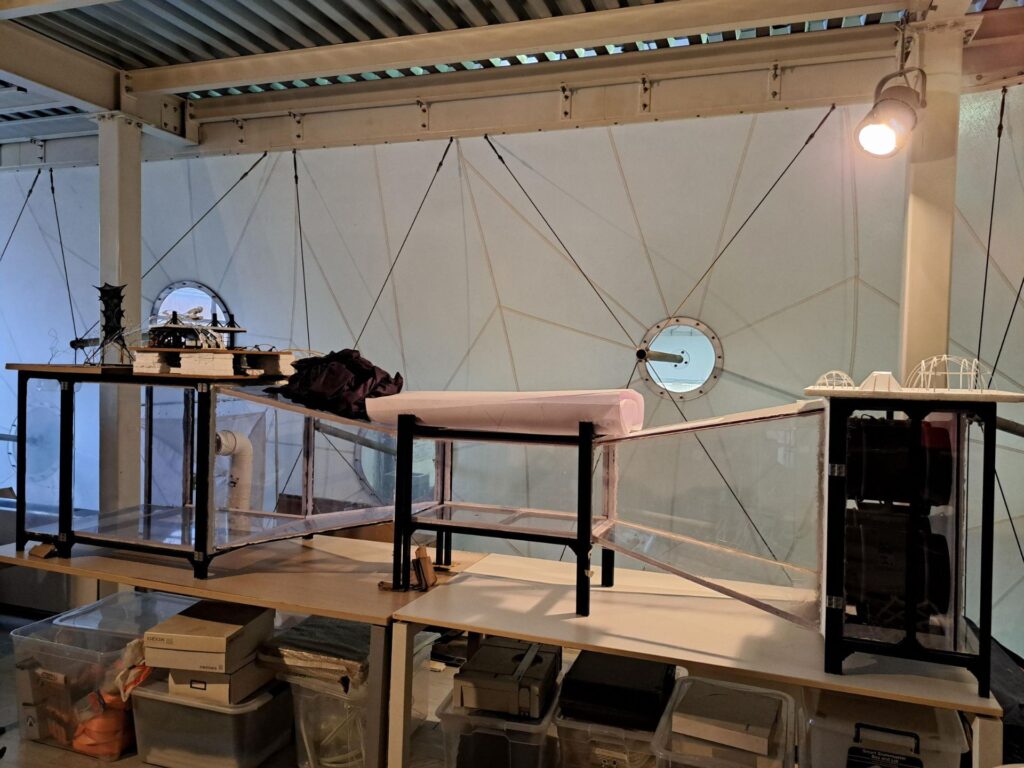
In Italy, there are still no large-scale applications for this technology, which has suitable environments on the Strait of Messina, and also between Liguria and Tuscany. «We are studying a system for collecting dew water to be used in cases of radiation fog, such as that found in the Po Valley» she concludes. The TEXTILES HUB is also the only academic research lab in Europe that deals with this technology, with a machine built in the Labora modelling lab of the Politecnico.